
The Thermodynamic Ceiling of Biological Filtration
In the modern industrial management of livestock housing, the mitigation of ammonia (NH3) emissions has traditionally relied on biological mechanisms. As documented by leading agricultural research institutions, biofilters are engineered to create an aerobic environment where specific bacterial colonies degrade odorous compounds. While these systems can achieve significant reductions in hydrogen sulfide (H2S) and general odor, they face a fundamental thermodynamic limitation when targeting ammonia. The microbial degradation of NH3 into nitrates or nitrites is a highly energy-dependent process that requires precise control of oxygen concentration, moisture content, and temperature. During peak production cycles—particularly in winter months when ventilation rates are reduced to conserve thermal energy—the kinetic equilibrium of the biofilter is frequently disrupted, leading to breakthrough concentrations that exceed occupational safety limits.
LumenAxys™ introduces a paradigm shift in livestock ammonia removal systems by moving away from biological dependency toward direct chemical sequestration. Utilizing Zinc Ricinoleate, a plant-based organic zinc salt derived from castor oil, our technology provides a robust, non-biological alternative for capturing volatile nitrogen species directly within the exhaust stream.
Molecular Coordination: Breaking the Urea Resonance Barrier
To understand the efficacy of LumenAxys™, one must analyze the molecular interactions at the atomic level. In animal housing, ammonia originates primarily from the enzymatic breakdown of urea present in urine, catalyzed by urease excreted in feces. This reaction produces gaseous NH3, which possesses a lone pair of electrons on the nitrogen atom, making it a strong Lewis base.
Traditional physical filters rely on van der Waals forces, which are insufficient to permanently trap NH3. Sodium bicarbonate (NaHCO3), a common chemical amendment, operates via acid-base neutralization; however, its capacity is limited by stoichiometry and its effectiveness degrades rapidly under the high humidity conditions typical of swine and poultry barns. In contrast, the Zn2+ cation in LumenAxys™ acts as a potent Lewis acid. The ricinoleate ligand, featuring a carboxylate group and a hydroxyl group, creates a complex steric environment around the zinc center. When exposed to NH3, the nitrogen's lone pair forms a stable coordinate covalent bond with the zinc ion. This interaction does not merely mask the odor; it chemically locks the nitrogen atom into a solid-phase matrix, preventing re-volatilization even if the local microclimate shifts.
Industrial Validation and Gas Sampling Parameters
The performance of any exhaust treatment system must be validated through rigorous sampling protocols. In standard industrial testing for livestock facilities, ambient air is drawn from the mechanical ventilation exhaust using calibrated pumps. To evaluate the efficiency of LumenAxys™ against traditional methods, we utilize a 10-liter Tedlar bag sampling technique, which captures the off-gas for subsequent analysis via Gas Chromatography-Mass Spectrometry (GC-MS).
- Baseline Concentration: In unmitigated poultry house environments, ammonia levels frequently range between 20 ppm and 50 ppm, significantly exceeding the recommended maximum threshold of 25 ppm for optimal bird health and worker safety.
- Biofilter Saturation Point: Conventional biofilters typically show a linear reduction curve until the active biomass reaches saturation, after which breakthrough occurs. Under a space velocity of 108,000 h-1 (a metric observed in high-capacity sorbent studies), biological systems struggle to maintain sub-ppm levels without massive increases in footprint and energy consumption.
- LumenAxys™ Kinetic Capture: In controlled chamber tests simulating high-density livestock waste, LumenAxys™ impregnated media demonstrated rapid adsorption kinetics. By integrating the zinc ricinoleate matrix into the filtration stage of existing HVAC systems, the exit air concentration was consistently driven down to parts-per-billion (ppb) levels. Unlike biological sludge, which requires regeneration cycles involving heat and water, the coordination complexes formed by LumenAxys™ remain stable under standard operating temperatures, eliminating the need for frequent media replacement associated with saturated biological beds.
Advantages Over Conventional Sorbents and Dietary Manipulation
While dietary manipulation—such as supplying crystalline amino acids to reduce total nitrogen excretion—is a valid upstream strategy, it does not address the residual ammonia generated by undigested feed protein or wasted feed. Furthermore, recent innovations in "drop-in" sorbent and catalytic conversion systems (like the SorboCAT platform) have shown promise but often require complex thermal swing operations (adsorption at 30°C and desorption at 250°C) to regenerate the sorbent. These high-energy requirements make them less economically viable for large-scale, continuous operation in remote agricultural settings.
LumenAxys™ offers a simpler, more sustainable solution. As a plant-based compound, it aligns with the industry's growing demand for environmentally benign technologies. It functions as a true scavenger rather than a reversible carrier. By forming irreversible bonds with the nitrogen species, it eliminates the downstream burden of hazardous waste disposal or the energy-intensive costs of thermal desorption. For a facility processing manure from thousands of head, the ability to integrate this passive chemical barrier into existing ductwork represents a critical upgrade in operational efficiency and regulatory compliance.
Engineering the Steric Shield for Livestock Air Quality
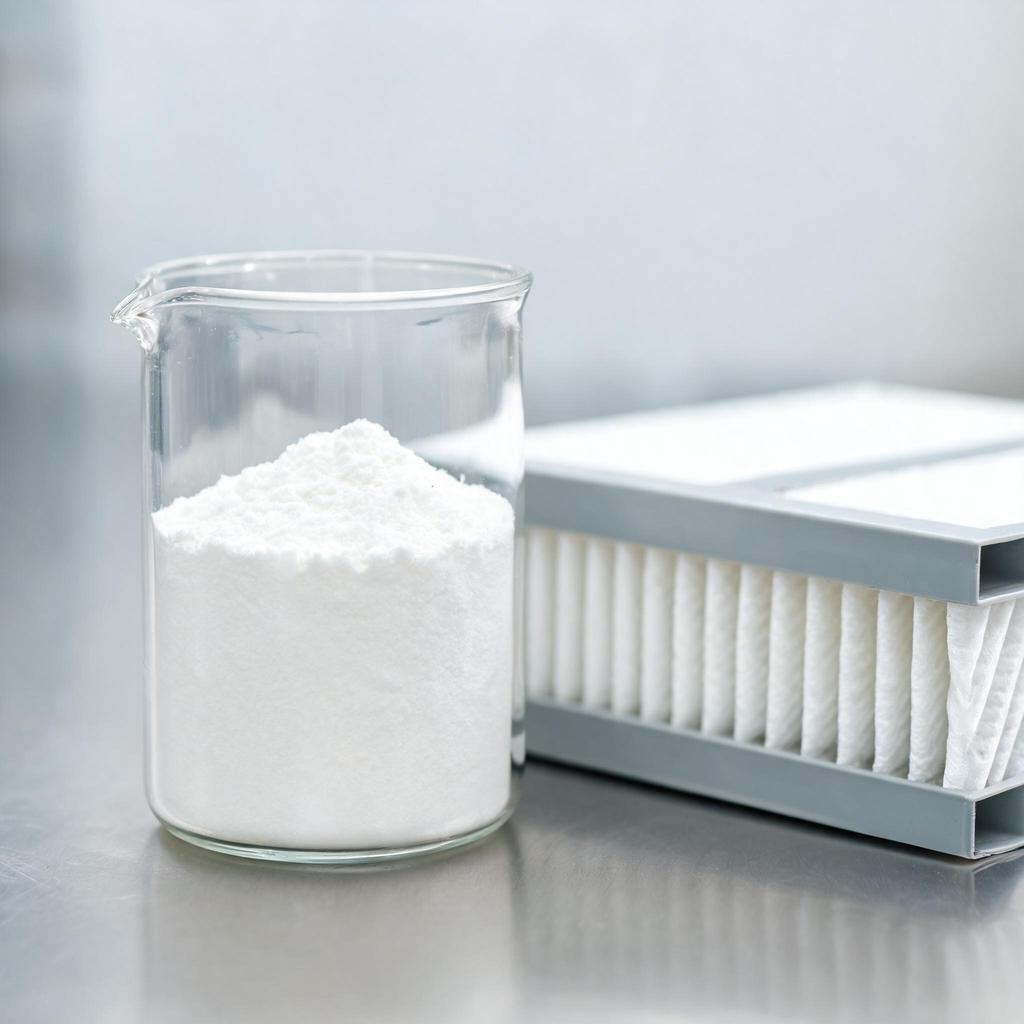
The implementation of LumenAxys™ in a livestock ammonia removal system requires careful engineering of the delivery medium. Whether applied as a coating on exhaust duct linings or integrated into pleated filter cartridges, the distribution of the zinc ricinoleate must ensure maximum surface area exposure to the turbulent airflow. The steric shield provided by the ricinoleate chains prevents the zinc centers from being blocked by particulate matter (dust and dander) that characteristically accompanies livestock exhaust. This ensures that the active coordination sites remain accessible throughout the operational lifespan of the filter.
By shifting the focus from biological metabolism to direct chemical coordination, LumenAxys™ addresses the root cause of indoor air quality degradation in animal agriculture. It provides a reliable, consistent, and scientifically superior method for protecting both the respiratory health of the flock and the occupational safety of farm workers.
Frequently Asked Questions
How does LumenAxys™ differ from standard sodium bicarbonate amendments?
Sodium bicarbonate relies on simple acid-base neutralization and is highly susceptible to saturation and washout in humid environments. LumenAxys™ utilizes the formation of a coordinate covalent bond between the Zn2+ ion and the NH3 molecule, creating a much more stable and permanent sequestration mechanism that resists re-volatilization.
Can this technology be integrated into existing ventilation systems?
Yes. LumenAxys™ is designed to function as a drop-in filtration media. It can be integrated into the mechanical ventilation exhausts of mechanically ventilated buildings without requiring major structural modifications, serving as a final polishing stage after primary dust collection.
Is the product safe for use in food-producing animal facilities?
Yes. LumenAxys™ is derived from plant-based sources (castor oil) and utilizes non-toxic zinc salts. It is designed specifically for industrial and agricultural air quality applications and does not introduce harmful heavy metals or synthetic toxicants into the environment.
What is the expected lifespan of the LumenAxys™ filter media?
The lifespan depends on the initial concentration of ammonia and the total volume of air treated. However, because the reaction is a chemical sequestration rather than a physical adsorption that can be reversed by humidity changes, the media maintains its functional integrity until the available coordination sites are fully occupied, offering a predictable and measurable service life.