
Traditional materials passively wait for odor molecules to drift into their pores, whereas the free zinc ions released by SORB CL actively track hydrogen sulfide (poop odor) and ammonia (urine odor) molecules like radar. Zinc ions engage in an irreversible chemical coordination reaction with sulfur and nitrogen atoms, permanently locking them into odorless, stable macromolecular salts.
In our dry gas collision lab tests, we achieved a conservative "90% clearance rate within 2 hours". However, in a real litter box scenario, the high-humidity environment created by pet waste instantly activates the plant fiber skeleton, massively accelerating the release and diffusion of internal zinc ions to form a 3D "liquid-phase water film capture net". This liquid-phase chemical complexation in wet environments exponentially increases the reaction speed!
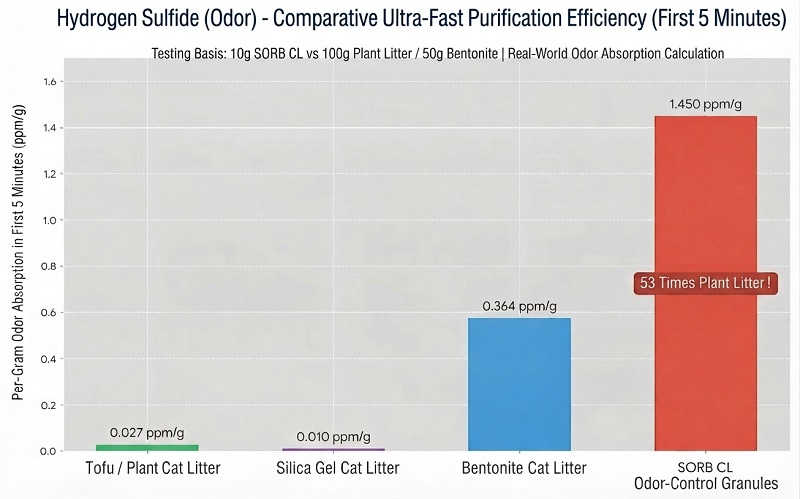
H2S (Poop Odor) Rapid Purification
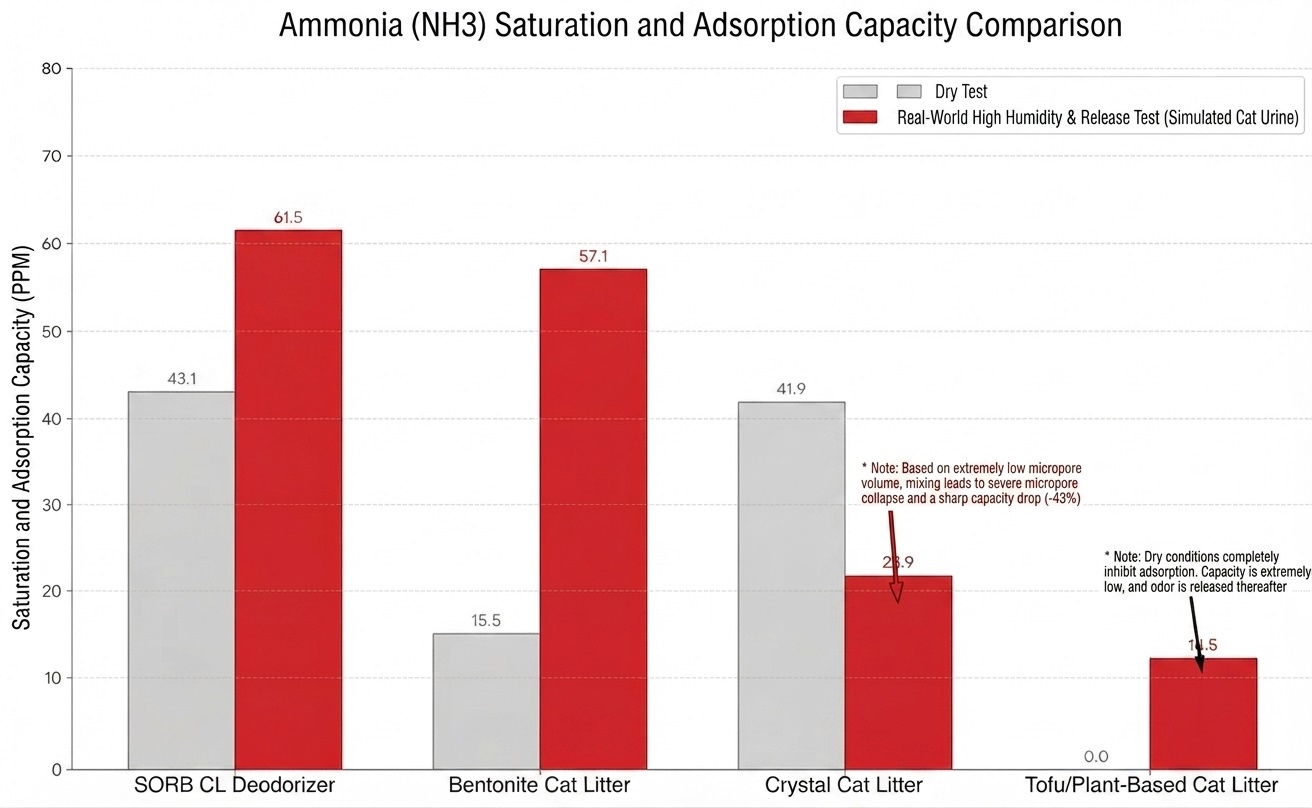
NH3 Ultimate Saturation Capacity
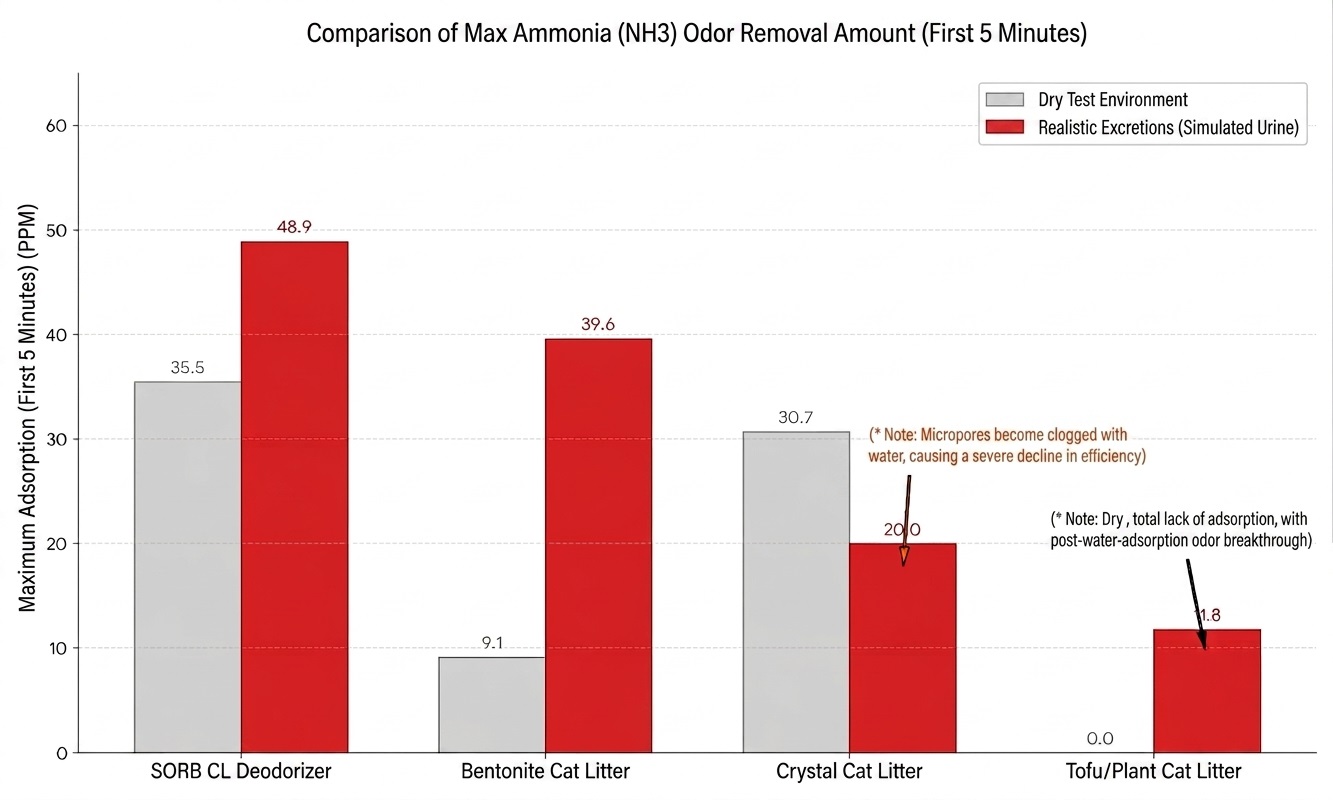
NH3 Golden 5-Min Max Removal
Disadvantages of Tofu/Plant Litter
Fails in Dry States: 0.0 PPM absorption in dry environments, completely lacking deodorizing ability.
Odor Rebound Risk When Wet: Absorbs weakly, but physically trapped odors are released slowly later, causing secondary stink.
Immune to H2S (Feces Odor): Barely any absorption capacity for hydrogen sulfide, wet or dry.
Disadvantages of Crystal Litter
Fails When Wet: Highly dependent on dry environments. In real wet scenarios, pores are blocked by water, dropping 5-min absorption to 20 PPM.
Poor H2S Handling: Barely absorbs hydrogen sulfide, especially when wet.
Disadvantages of Bentonite Litter
Extremely Slow Activation: Misses the golden window, allowing odors to rapidly diffuse into the room before being absorbed.
Decreased H2S Absorption When Wet: Moisture interferes with pores, significantly reducing the total deodorizing capacity (drops from 64 to 35).
👑 The Absolute Ruler: SORB CL Zinc Ion Deodorizer
[Commercial Positioning: Water-Activated Targeted Weapon, Dual-State Dominance]H2S Performance: Crushing dominance. Over 90% absorption rate in 5 mins, killing feces odor in seconds.
NH3 Performance: A dimensional leap ahead of all competitors.
Golden 5-Min Burst: Activated by moisture rather than weakened. Absorbs 48.9 PPM in the first 5 mins when wet—over 4x more than tofu.
Extreme Redundancy: Ultimate saturation capacity hits 61.5 PPM. Bottomless potential in a fully active state.
Core Moat: Ditches inefficient physical pores for irreversible chemical bonding. Locks odors permanently with zero rebound risk!
🏭 25kg Industrial Bulk (B-End Factory Choice)
- Universal Compatibility: Perfectly matches tofu, bentonite, or blended litter. The plant-based skeleton matches the density of litters, completely solving traditional mineral flaws of sinking, layering, and dusting.
- Simple Dry Mixing & OEM Services: Zero equipment modifications required. Just dry-mix the granules into finished litters at a ratio of 1%-10% (5% recommended). We also provide mature OEM/ODM contract manufacturing services to help you quickly launch premium deodorizing litter lines.
🛍️ 250g Retail & OEM Custom (C-End Breakthrough)
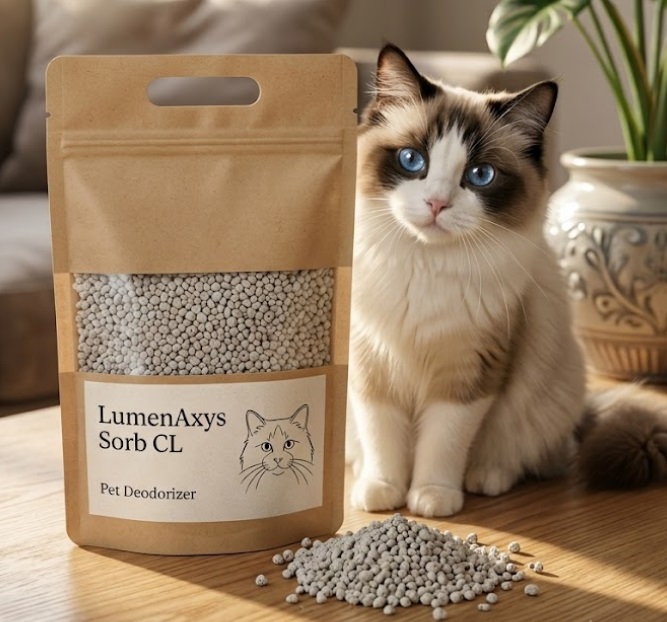
- Perfect Companion: Premium kraft paper bags, ready for OEM branding. Consumers can add it to any commercial litter for robust, long-lasting odor control.
- Base Mixing: When pouring fresh litter (e.g., standard 2.5kg bag), sprinkle in about 50g of granules and mix slightly.
- Daily Maintenance: Scoop clumps normally. Sprinkle a small amount after cleaning to effortlessly maintain a fresh environment for 3-4 weeks.
- Advanced 3D Odor Control (Recommended): Pair with [SORB CL Odor Spray]. Granules "ambush" bottom odors long-term, while the spray "instantly pierces" surface odors of fresh feces.
- Cross-Space Deodorization: Pack granules into breathable bags and place them near shoe cabinets, bathrooms, or kitchen waste as long-lasting odor absorbers.
| Performance Dimension | SORB CL (Plant-based Zinc) | Activated Carbon | Baking Soda | Biological Enzymes | SAP (Super Absorbent Polymer) |
|---|---|---|---|---|---|
| Mechanism | Irreversible Chemical Complexation | Pure Physical Pore Adsorption | Weak Acid-Base Neutralization | Biocatalytic Degradation | Physical Water Lock |
| High-Humidity | Water-Activated, Effect Doubled | Poor (Pores Blocked by Vapor) | Prone to Caking & Failure | Poor (Mold Growth Risk) | Rapid Swelling & Saturation |
| Targeted Broad Spectrum | Dual Target (H2S + NH3) | Blind Adsorption (Desorption Risk) | Acidic Odors Only | Highly Specific, Narrow Scope | Targets Liquids Only |
| Activation Speed | Minutes (Reacts on Contact) | Slow (Relies on Gas Diffusion) | Slow | Extremely Slow (Fermentation) | None |
| Secondary Release | Zero Risk (Forms Stable Salts) | High (Releases on Temp Change) | Medium | High (Odor Rebounds) | High (Odor Leaks as Water Evaporates) |