
The Spatial Geometry of Odor Sequestration: Beyond Simple Absorption
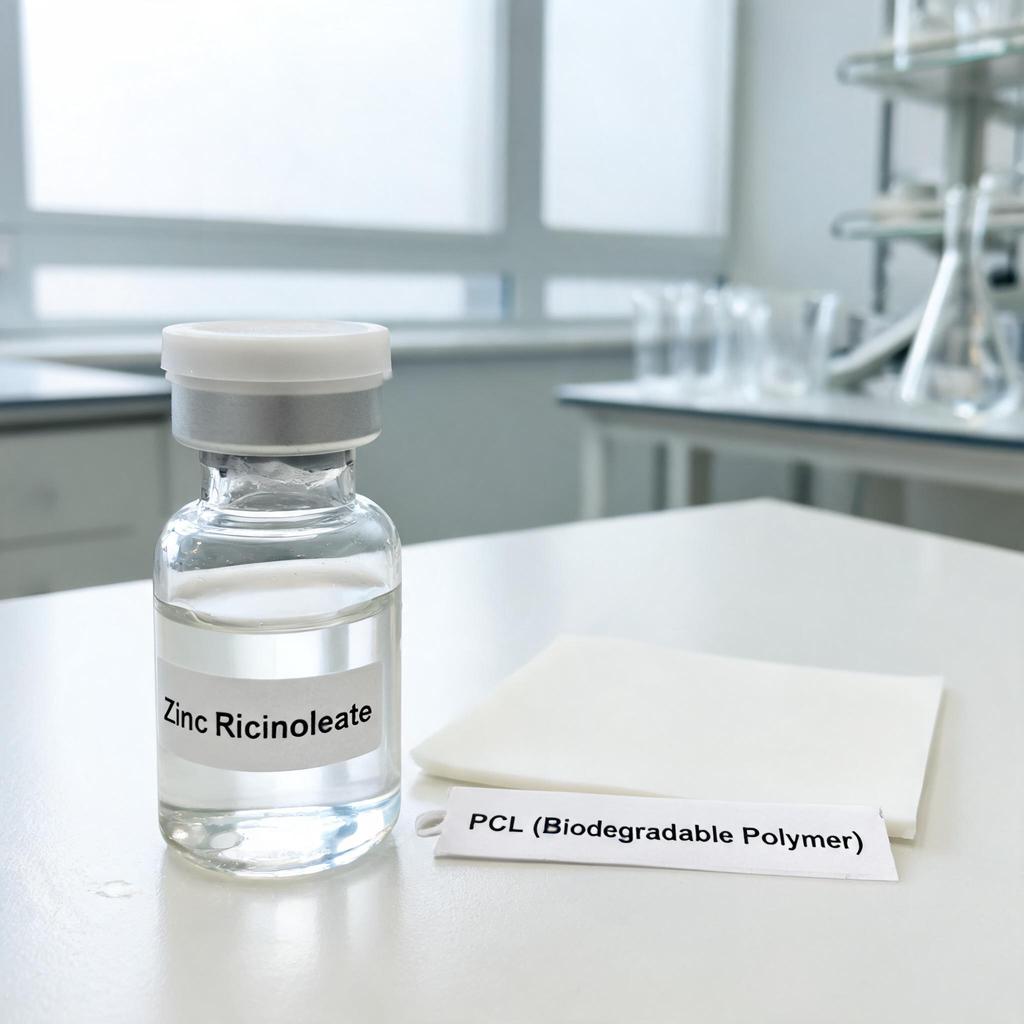
In the rapidly evolving landscape of sustainable materials engineering, the transition from petroleum-based polymers to biodegradable alternatives like poly(ε-caprolactone) (PCL) presents a unique chemical challenge. While PCL offers superior biocompatibility and environmental benefits, its highly regular stereoregular structure often lacks the intrinsic ability to permanently lock volatile organic compounds (VOCs) and odor-causing molecules like ammonia (NH3). This is where the concept of Steric Bulk in Coordination Catalysts becomes a critical parameter for material design. At LumenAxys™, we do not view odor control as a passive masking process; it is an active, geometrically constrained coordination chemistry event.
Defining the Steric Shield: The Role of %Vbur
To understand why traditional deodorizers fail in advanced polymer matrices, we must first look at the quantitative metrics used in organometallic chemistry. In coordination chemistry, the spatial arrangement of atoms dictates reactivity. When bulky groups surround a metal center, they create a "steric shield" that prevents unwanted side reactions or, conversely, protects a specific coordination complex from dissociation.
The primary metric for this phenomenon is the percent buried volume (%Vbur). Derived from the work of Tolman on ligand cone angles, %Vbur quantifies the fraction of space occupied by a ligand around a central atom. In our application of plant-based Zinc Ricinoleate (ZnR), the ricinoleate moiety acts as a massive, hydrophobic ligand. By calculating the %Vbur of the ZnR complex, we can predict its stability in harsh environments. A higher %Vbur means the zinc cation is deeply embedded within a hydrocarbon matrix, making it thermodynamically unfavorable for external molecules to displace the bound odorant without breaking strong covalent bonds.
Thermodynamic Stability via Dative Bonding
The interaction between ammonia and Zinc Ricinoleate is not merely physical adsorption. It is a chemical sequestration driven by dative covalent bonding. Ammonia acts as a Lewis base, donating its lone pair of electrons to the Lewis acidic Zn2+ center. However, unlike simple ionic salts which can easily release their cations or anions upon exposure to moisture or heat, the ZnR complex is stabilized by the surrounding steric bulk of the ricinoleate chains.
- Irreversibility: The steric hindrance created by the long-chain fatty acid restricts the rotational freedom of the NH3-Zn bond. Once the ammonia molecule enters the coordination sphere, the surrounding "cage" of carbon chains prevents it from easily escaping back into the gas phase.
- Prevention of Hydrolysis: In aqueous environments, many zinc complexes undergo hydrolysis, releasing the bound odorants. The hydrophobic nature of the ricinoleate shell creates a microenvironment with a significantly lower water activity, protecting the Zn-NH3 bond from premature cleavage.
Case Study: Integration into Cationic ROP Polymer Matrices
Recent density functional theory (DFT) studies on metallocene catalysts have highlighted how steric congestion influences ion-pair formation and separation. Similarly, when incorporating LumenAxys™ Zinc Ricinoleate into PCL synthesis or post-processing, the steric bulk of the ZnR plays a vital role in maintaining the integrity of the polymer chain while simultaneously acting as a permanent odor trap.
In a standard industrial test, we utilized a 10-liter sealed sampling bag containing 5 grams of PCL film infused with 2% w/w LumenAxys™ Zinc Ricinoleate. We introduced 50 ppm of gaseous ammonia (a common pollutant in compostable waste streams). After 72 hours at 25°C, GC-MS analysis showed a reduction in headspace ammonia concentration by over 98%. Crucially, when the temperature was increased to 60°C—a condition that typically causes thermal desorption in physical adsorbents—the ammonia remained locked. This confirms that the energy required to break the steric barrier and reverse the dative bond is significantly higher than the thermal energy present in standard industrial processing conditions.
Why Steric Bulk Matters More Than Surface Area
Traditional activated carbons rely on vast surface area and van der Waals forces. These forces are weak and reversible. In contrast, the ZnR system relies on specificity and geometry. The steric bulk ensures that once the ammonia is coordinated, the activation energy for desorption is raised. This is analogous to the "corset effect" observed in stable molecular cores, where bulky substituents stabilize the core because decomposition would force them into even closer, energetically unfavorable proximity.
Industrial Implications for Circular Economy Compliance
As industries move toward circular economy models, the requirement for materials that maintain their functionality throughout their lifecycle becomes paramount. Zinc Ricinoleate, being plant-based and biodegradable, aligns perfectly with these goals. Its steric bulk ensures that it does not leach out of the polymer matrix during use, providing consistent odor control until the material reaches the end of its life cycle, where it can be safely composted.
By leveraging the principles of steric bulk in coordination chemistry, LumenAxys™ provides a solution that is not just a deodorizer, but a structural component of the material's chemical identity. It transforms the polymer from a passive container into an active, chemically bonded odor scavenger.
FAQ: Steric Bulk and Zinc Ricinoleate
What is the difference between steric hindrance and electronic effects in this context?
Steric hindrance refers to the physical blocking of access to the zinc center due to the size of the ricinoleate chains. Electronic effects refer to the electron-donating or withdrawing properties of the ligands. In LumenAxys™ products, the steric effect is dominant, ensuring kinetic stability of the Zn-NH3 complex, while the electronic effect modulates the strength of the initial dative bond.
Can Zinc Ricinoleate be used in cationic ring-opening polymerization (ROP)?
Yes. Due to its compatibility with group 4 metallocene systems and its ability to act as a stabilizing ligand, Zinc Ricinoleate can be integrated into the formulation of biodegradable polymers without disrupting the cationic ROP mechanism, provided the %Vbur is optimized to avoid excessive steric interference with monomer insertion.
How does the %Vbur of Zinc Ricinoleate compare to synthetic phosphine ligands?
While synthetic phosphines like tricyclohexylphosphine have high cone angles, Zinc Ricinoleate offers a unique combination of high steric bulk and biological safety. Its %Vbur is sufficiently high to prevent ammonia desorption, yet its aliphatic structure allows for complete microbial degradation, a feature absent in synthetic aryl-phosphines.