
The Hidden Cost of PCR Plastic Malodor
Post-consumer recycled (PCR) plastics are the cornerstone of sustainable manufacturing, yet they carry a persistent operational headache: trapped volatiles. During municipal collection, storage, and high-temperature reprocessing, polymer chains degrade, releasing a complex cocktail of low-molecular-weight organics. These compounds include short-chain carboxylic acids, residual amines, and trace sulfur species that survive standard washing cycles. Traditional masking fragrances only create a chemical clash, often exacerbating sensory fatigue on the factory floor and compromising downstream applications like 3D printing filaments or WPC decking.
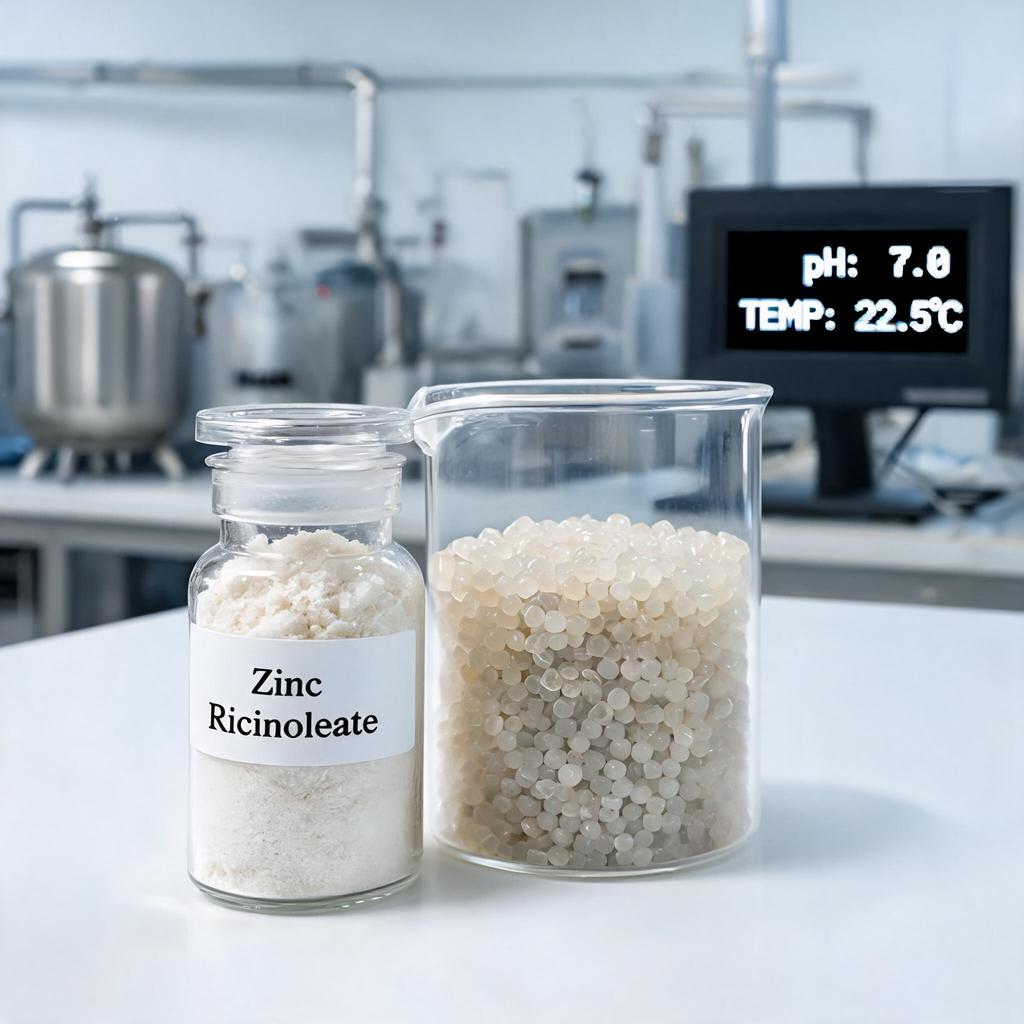
LumenAxys™ plant-based Zinc Ricinoleate addresses this challenge through direct molecular capture rather than olfactory deception. By integrating this specialized zinc salt of ricinoleic acid into polymer masterbatches, manufacturers achieve fundamental odor elimination at the source. The solution operates seamlessly within extrusion lines, transforming problematic recycled feedstocks into odor-free, high-grade pellets.
Molecular Mechanism: Coordination Chemistry in Action
Lewis Acid-Base Complexation
The efficacy of Zinc Ricinoleate lies in its dual structural architecture. The central zinc ion (Zn2+) functions as a potent Lewis acid. When exposed to the polar headgroups of odor molecules—such as the nitrogen atom in ammonia (NH3) or the sulfur atom in hydrogen sulfide (H2S)—the Zn2+ center forms stable dative covalent bonds. This coordination complex effectively immobilizes the volatile compound, drastically reducing its vapor pressure and preventing atmospheric release.
Simultaneously, the ricinoleate moiety provides a long, unsaturated hydrocarbon tail derived directly from castor oil. This lipophilic chain ensures exceptional compatibility with polyolefin and polyester matrices. Unlike water-soluble neutralizers that phase-separate during melt processing, Zinc Ricinoleate disperses uniformly throughout the molten polymer, acting as an internal gas-phase scrubber.
Thermal Stability & Extrusion Compatibility
Recycled plastic processing demands materials that withstand severe thermal stress. Standard deodorizers often decompose above 180°C, losing efficacy precisely when polymer degradation peaks. LumenAxys™ Zinc Ricinoleate maintains structural integrity up to 220°C, the typical operating window for PP/PE extruders. The conjugated double bond in the ricinoleate chain remains stable under standard shear forces, ensuring continuous odor capture throughout the pelletizing cycle without catalyzing unwanted cross-linking or discoloration.
Industrial Validation Protocol: Tedlar Bag Testing
Sampling Methodology & Quantifiable Results
To validate performance, LumenAxys™ employs rigorous gas-phase testing aligned with ISO standards. A standardized protocol utilizes 10-liter Tedlar® sampling bags. Recycled plastic samples are heated in a controlled environmental chamber to simulate processing temperatures, driving volatiles into the headspace. The bag is sealed and analyzed via GC-MS alongside an olfactory panel.
In controlled trials comparing untreated PCR pellets against formulations containing 1.5% Zinc Ricinoleate, results demonstrated a >92% reduction in target VOC concentrations. The characteristic sour, rubbery, or fecal notes associated with degraded polypropylene were eliminated, yielding a neutral, clean profile. The gas-phase neutralization occurs rapidly upon contact with the headspace volatiles, proving that the zinc centers actively scavenge escaping molecules before they breach the packaging.
Implementation Strategies for Polymer Manufacturers
Integrating Zinc Ricinoleate into existing production lines requires precise dosing and dispersion techniques. The optimal loading rate ranges from 1.0% to 3.0% by weight, depending on the initial contamination level of the feedstock. For maximum efficiency, the powder should be pre-dispersed into a compatible carrier resin or oil phase prior to main extruder feeding. This prevents localized agglomeration and ensures uniform distribution throughout the final pellet.
Manufacturers should monitor the final pH of the molten matrix. While Zinc Ricinoleate functions independently of bulk pH adjustments, maintaining a near-neutral environment prevents potential hydrolysis of the ester linkages. When compounded into masterbatches, it synergizes with existing antioxidant packages (e.g., hindered phenols and phosphites) without catalytic interference, preserving the mechanical tensile strength and melt flow index (MFI) of the recycled polymer.
Frequently Asked Questions
- Q: Does Zinc Ricinoleate alter the physical properties of recycled plastics?
A: No. Because it is chemically compatible with polyolefins, it integrates into the polymer matrix without disrupting crystallinity, melt flow, or tensile strength. It functions solely as a molecular trap for volatiles. - Q: How does it differ from carbon-based adsorbents or masking fragrances?
A: Activated carbon relies on physical physisorption, which saturates quickly and cannot handle high-temperature extrusion. Fragrances merely mask odors, creating unpleasant chemical blends. Zinc Ricinoleate utilizes irreversible coordination bonding to permanently neutralize odor molecules at the molecular level. - Q: What is the recommended processing temperature limit?
A: LumenAxys™ Zinc Ricinoleate is thermally stable up to approximately 220°C, making it ideal for standard recycling extrusion and pelletizing operations where polymer degradation releases the worst volatiles. - Q: Can it be used in 3D printing filaments made from recycled PETG or PLA?
A: Absolutely. By incorporating 1-2% into the filament extrusion process, it eliminates the acetic or lactic acid byproducts that cause workspace irritation during melting, ensuring a cleaner printing environment. - Q: How is the dosage determined for highly contaminated feedstocks?
A: For municipal-sourced PCR with heavy environmental absorption, a 2.5-3.0% loading is recommended. The lipophilic nature ensures it disperses evenly, providing sustained gas-phase scavenging throughout storage and subsequent processing.