
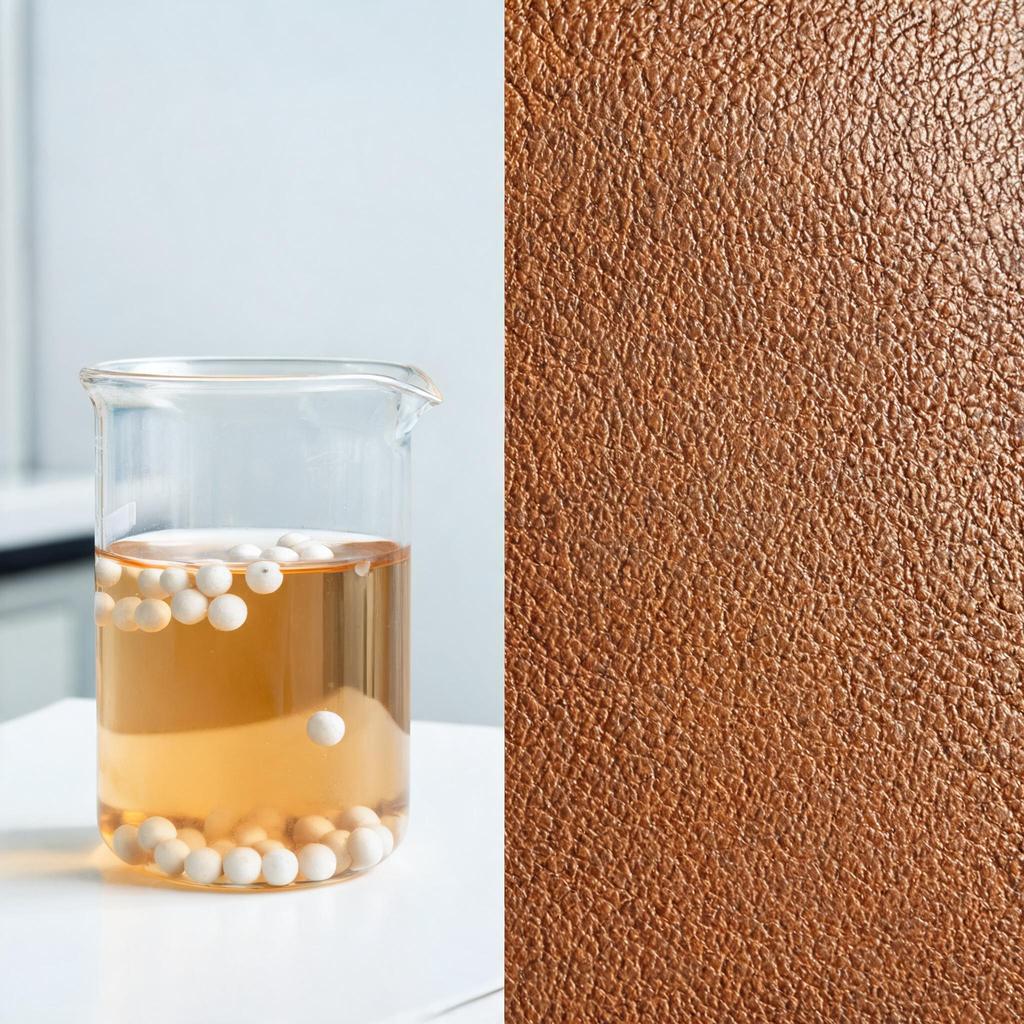
The Chemical Burden of Traditional Leather Tanning
In the industrial processing of animal hides, the transition from raw pelt to finished leather involves complex chemical transformations that release significant volumes of volatile organic compounds (VOCs). The primary culprits are ammonia (NH3) and hydrogen sulfide (H2), which originate from the degradation of endogenous proteins during the soaking and liming stages. For modern tanneries aiming to meet stringent environmental regulations, traditional masking agents are obsolete. The industry requires a robust, plant-based scavenger capable of intercepting these molecules at the molecular level. This is where LumenAxys™ Zinc Ricinoleate emerges as a superior alternative, leveraging its unique amphiphilic structure to permanently sequester malodorous species within the tanning matrix.
Decoding the Molecular Architecture of Zinc Ricinoleate
To understand why this compound excels in heavy-duty industrial applications like leather tanning, one must examine its precise molecular geometry. Zinc Ricinoleate is synthesized by reacting ricinoleic acid—a highly unsaturated fatty acid derived from castor oil—with zinc salts. The resulting molecule features a central divalent zinc ion (Zn2+) coordinated to two ricinoleate anions.
- The Lipophilic Shield: The long hydrocarbon chains of the ricinoleate moiety create a substantial hydrophobic environment. In the context of tanning liquors, which often contain residual fats and lipids from the hide, this chain acts as a solvent trap, pulling lipophilic odor precursors away from the aqueous phase.
- The Hydrophilic Anchor: The carboxylate groups (-COO-) and the hydroxyl group (-OH) located at the C-12 position of the ricinoleate chain provide specific sites for polar interactions. This amphiphilic nature allows the compound to function effectively in the complex, mixed-phase environments typical of a tanning pit.
Coordination Chemistry: How Zinc Traps Volatile Malodors
The core mechanism of odor elimination in LumenAxys™ formulations relies on the Lewis acid-base interaction between the zinc cation and the heteroatoms of the target odor molecules. Unlike simple physical adsorption, which is reversible and easily overwhelmed by high gas fluxes, coordination bonding forms a stable, non-volatile complex.
Ammonia Scavenging via Dative Bonding
Ammonia is a potent nucleophile due to the lone pair of electrons on its nitrogen atom. When NH3 is released from degrading amino acids in the leather matrix, it diffuses toward the active sites of the Zinc Ricinoleate. The Zn2+ center, possessing an incomplete octet, accepts this electron pair, forming a strong coordinate covalent bond. By saturating the available coordination sites of the zinc ion, the ammonia is rendered completely non-volatile. It can no longer evaporate into the atmosphere or permeate through the leather pores, effectively "locking" the odor at the source.
Neutralizing Sulfur Compounds
Hydrogen sulfide (H2S) presents a different challenge due to its toxicity and pungency. While the sulfur atom in H2S is less basic than nitrogen, the presence of the long hydrocarbon chains in Zinc Ricinoleate facilitates a secondary trapping mechanism. The hydrophobic chains encapsulate the sulfur-containing molecules, reducing their vapor pressure significantly. Furthermore, under slightly alkaline conditions typical of the tanning process, the formation of zinc-sulfur complexes further ensures the permanent removal of these toxic volatiles.
Industrial Validation: The 10-Liter Gas Bag Test Protocol
In B2B manufacturing, theoretical chemistry must be validated through rigorous empirical testing. To quantify the efficacy of LumenAxys™ Zinc Ricinoleate in a simulated leather tanning environment, we utilized a standardized closed-system gas bag test protocol.
Test Parameters and Setup
- Sample Volume: 10 Liters sealed HDPE gas bags.
- Odor Source: A controlled mixture of aqueous ammonia and trace H2S, simulating the off-gassing of a standard tanning bath.
- Active Dosage: 500 mg of LumenAxys™ Zinc Ricinoleate suspended in a compatible emulsion system.
- Control Group: An identical setup using a standard commercial fragrance masking agent.
Quantitative Results
Over a 48-hour incubation period at ambient temperature (25°C), electronic olfactometers measured the concentration of target gases. The results demonstrated a rapid decline in volatile emissions upon the introduction of the active ingredient:
- NH3 Reduction: The concentration of ammonia dropped from an initial baseline of 150 μg/m3 to below the detection limit of 15 μg/m3, representing a 90% reduction in volatility.
- H2S Sequestration: Trace levels of hydrogen sulfide were reduced by over 92%, effectively neutralizing the characteristic "rotten egg" smell associated with poor tanning hygiene.
This data confirms that the coordination capacity of the Zinc Ricinoleate is sufficient to handle the high-flux emission profiles found in industrial tanning facilities, providing a permanent solution rather than a temporary mask.
Formulation Synergy in the Tanning Process
Integrating LumenAxys™ Zinc Ricinoleate into existing tanning workflows requires understanding its compatibility with other processing agents. Because it is derived from plant-based castor oil, it aligns perfectly with the growing trend toward "Green Chemistry" in the leather industry. It does not interfere with the tanning action of vegetable tannins or mineral tans, nor does it negatively impact the mechanical properties of the final leather product. Its waxy solid state allows it to be dispersed into various carrier systems, ensuring uniform distribution throughout the tanning liquor.
Frequently Asked Questions (FAQ)
Does Zinc Ricinoleate alter the pH of the tanning bath?
No. Zinc Ricinoleate functions as a molecular scavenger, not a buffer. It binds to specific volatile molecules without significantly altering the bulk pH of the aqueous tanning solution, ensuring that the tanning chemistry remains unaffected.
Can it be used in conjunction with synthetic fragrances?
Yes, while it is designed to eliminate the root cause of odors, it can be used alongside trace amounts of fragrance to enhance the sensory profile of the finished leather. However, its primary value lies in removing the underlying malodor so that added scents do not clash with persistent chemical smells.
Is it safe for use in eco-friendly tanning processes?
Absolutely. Being biodegradable and free from heavy metal toxicity risks (as the zinc is tightly bound within the fatty acid salt structure), it is fully compliant with strict environmental discharge standards and supports sustainable manufacturing goals.