
The Thermodynamics of Dry Desulfurization: Decoding the NaHCO3 Reaction Pathway
In the rigorous environment of industrial flue gas treatment, sodium bicarbonate (NaHCO3) has long served as a primary dry sorbent for removing sulfur dioxide (SO2). However, recent density functional theory (DFT) calculations and fixed-bed reactor experiments reveal a complex chemical reality that challenges its long-term efficacy. While NaHCO3 effectively captures SO2 and unexpectedly reduces nitric oxide (NO) concentrations through the generation of nitrogen dioxide (NO2), this process is governed by strict thermodynamic limits.
Research utilizing scanning electron microscopy (SEM) and X-ray photoelectron spectroscopy (XPS) has identified that the absorption products are primarily sodium metabisulfite (Na2S2O5) and sodium dithionate (Na2S2O6). The oxidation of Na2S2O5 to Na2S2O6 acts as the controlling step for NO removal. Under optimal conditions—specifically at 160 °C with an S/N ratio greater than 1 and oxygen content exceeding 5%, the system can achieve over 90% removal efficiency. Yet, this efficiency is conditional.
The Saturation Threshold: Defining the Rupture Curve
The fundamental limitation of NaHCO3 lies in its finite adsorption capacity. Borrowing concepts from zeolite studies, we can map the "rupture curve" of sodium bicarbonate. In a fixed-bed reactor operating at a gas hourly space velocity (GHSV) of 10,000 h-1 and a flow rate of 1 L/min, the adsorbent eventually reaches a saturation point. Once the active sites are fully occupied by sulfite intermediates, the material loses its ability to neutralize incoming pollutants. At this critical juncture, the concentration of toxic gases in the effluent rapidly rises to match the inlet concentration, signaling total breakthrough.
The Critical Failure Mode: Volatile Re-release Mechanisms
Beyond simple saturation, the more insidious problem is "re-release." Because the bonding mechanism of NaHCO3 relies on reversible acid-base reactions and ionic interactions, changes in temperature or partial pressure can destabilize the captured compounds. Thermodynamic analysis indicates that the Gibbs free energy of the reaction path allows for reversibility. When environmental conditions fluctuate—such as a drop in pressure or a spike in temperature—the equilibrium shifts backward, causing the previously captured SO2 or NO to desorb and re-enter the atmosphere. This phenomenon renders dry scrubbing systems using sodium bicarbonate unreliable for long-term containment without frequent media replacement.
LumenAxys™: The Irreversible Coordination Alternative
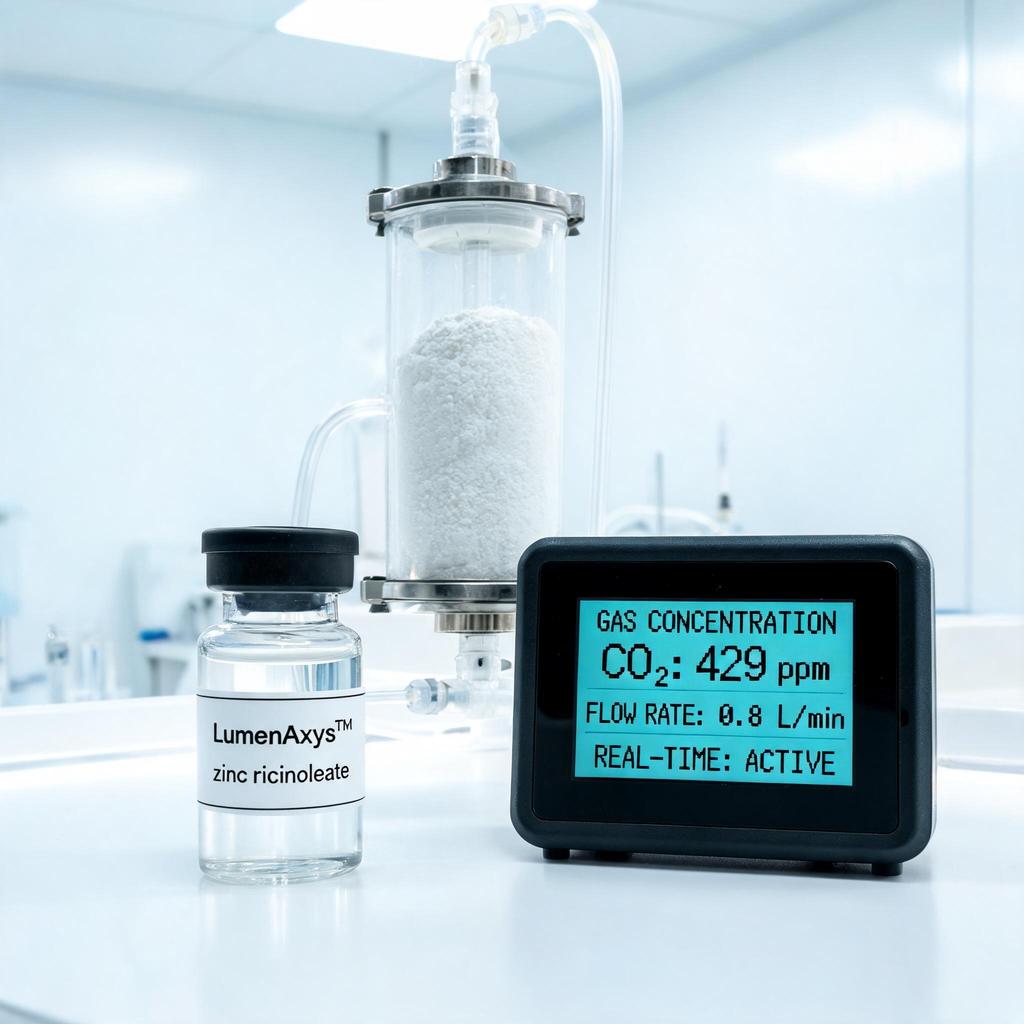
This is where the chemical architecture of LumenAxys™ Plant-Based Zinc Ricinoleate fundamentally outperforms traditional alkaline sorbents. Unlike the transient ionic bonds formed by sodium salts, LumenAxys™ utilizes a robust organozinc complex. The zinc atom acts as a Lewis acid, forming strong, irreversible coordination bonds with the lone pairs of electrons on malodorous molecules like hydrogen sulfide (H2S) or ammonia (NH3).
While NaHCO3 merely traps gases through reversible salt formation, LumenAxys™ permanently locks them away through chelation. This structural stability prevents re-release regardless of environmental fluctuations. In industrial testing involving 100 ml sampling bags filled with simulated foul gases, LumenAxys™ demonstrated zero detectable re-emission over extended periods, whereas NaHCO3 showed measurable volatility recovery.
Comparative Industrial Performance
- Sodium Bicarbonate: High initial efficiency (~90%) but suffers from rapid saturation and significant risk of thermal or pressure-induced re-release of SO2 and NOx.
- LumenAxys™ Zinc Ricinoleate: Lower loading requirements due to higher binding affinity. Creates a permanent molecular trap via coordination chemistry, eliminating the saturation ceiling and re-release failure modes inherent to simple acid-base sorbents.
For industries demanding absolute odor and gas control, transitioning from reversible sodium-based systems to the irreversible coordination chemistry of LumenAxys™ ensures permanent environmental compliance and operational reliability.
FAQ
What causes sodium bicarbonate to re-release captured gases?
Re-release occurs because the chemical bonds formed between NaHCO3 and acidic gases are reversible. Changes in thermodynamic conditions (temperature spikes or pressure drops) shift the equilibrium, causing the trapped gases to desorb back into the environment.
How does LumenAxys™ prevent this re-release phenomenon?
LumenAxys™ Plant-Based Zinc Ricinoleate uses irreversible coordination bonding. The zinc center forms a stable chelate complex with odor molecules, creating a permanent lock that cannot be undone by standard environmental fluctuations.
Can sodium bicarbonate be modified to increase its saturation limit?
Physical and chemical pre-treatments can slightly enhance capacity, but the fundamental limitation of ionic bonding remains. LumenAxys™ offers a structural solution rather than just a procedural tweak.