
The Chelate Effect: Why Polydentate Ligands Dominate Metal Coordination
In the realm of inorganic chemistry, the stability of metal-ligand complexes is not merely a function of bond strength but a complex interplay of thermodynamic and kinetic factors. For industrial applications like odor neutralization, understanding these principles is crucial. LumenAxys™ Zinc Ricinoleate exemplifies this by leveraging the inherent thermodynamic stability of zinc-nitrogen coordination complexes.
The chelate effect refers to the enhanced stability observed when a polydentate ligand binds to a metal ion compared to chemically similar monodentate ligands. This phenomenon arises from entropic advantages; the formation of a chelate ring reduces the number of independent particles in solution, leading to a favorable change in entropy (ΔS). For instance, ethylenediamine (en), a bidentate ligand, forms a five-membered chelate ring with Ni2+, resulting in a significantly more stable complex than would be formed with ammonia alone.
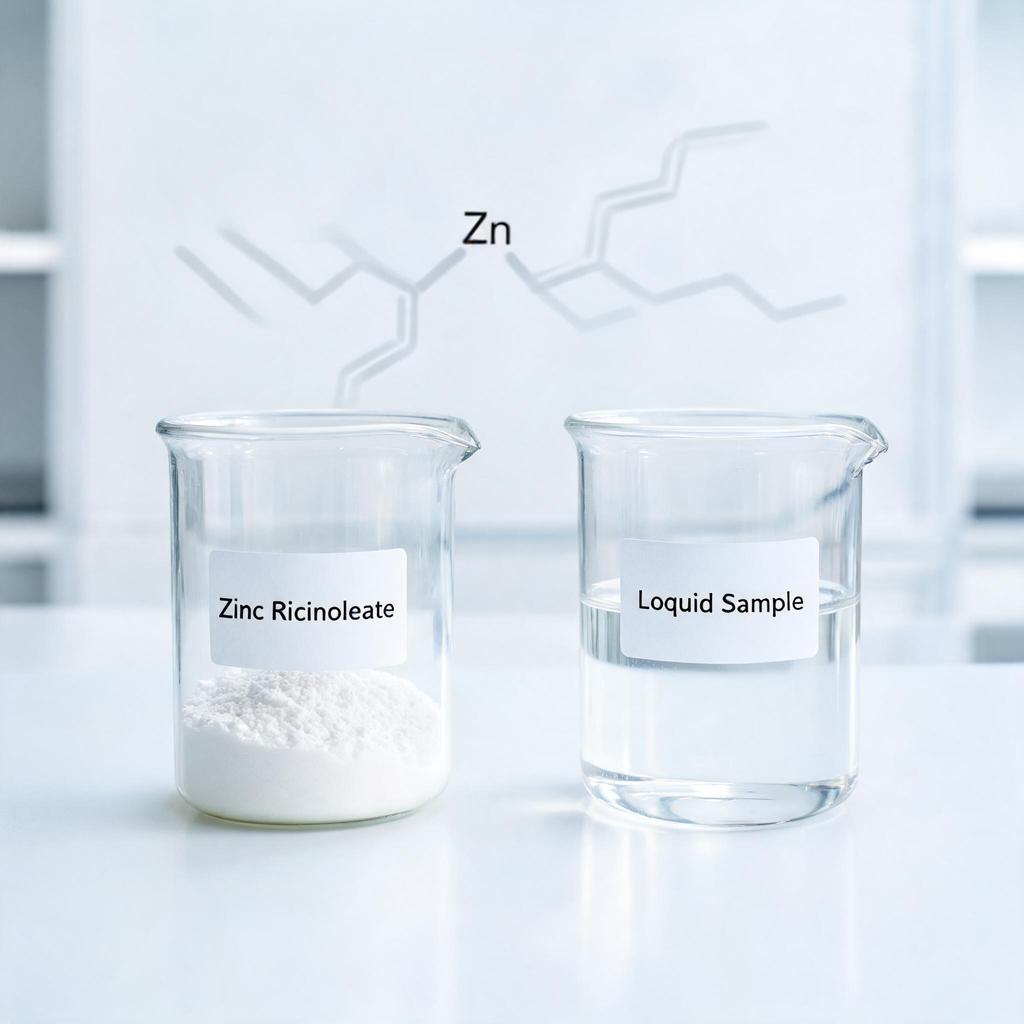
LumenAxys™ Zinc Ricinoleate utilizes ricinoleic acid, a hydroxylated fatty acid, as its ligand. The carboxylate group and the hydroxyl group can act as potential binding sites, creating a pseudo-chelate environment around the Zn2+ ion. This multi-point interaction enhances the overall stability of the complex, making it highly effective in sequestering volatile compounds like ammonia (NH3) and hydrogen sulfide (H2S).
Irving-Williams Series and the Anomaly of Copper(II)
The Irving-Williams series predicts the relative stability of first-row transition metal complexes with nitrogen-donor ligands, typically following the order Mn(II) < Fe(II) < Co(II) < Ni(II) < Cu(II) > Zn(II). However, experimental data often reveal deviations from this trend, particularly with certain ligand geometries.
A study on N,N,N′-tri(2-pyridylmethyl)glycinamide (L) demonstrated that the stability constants for Co(II), Ni(II), Cu(II), and Zn(II) did not conform to the Irving-Williams serial. Specifically, the Cu(II) complex exhibited unusually small stability constants. This anomaly was attributed to the specific steric and electronic demands of the pentadentate ligand, which may not optimally fit the preferred coordination geometry of Cu(II).
For LumenAxys™ Zinc Ricinoleate, the focus is on Zn(II), which, while generally less stable than Cu(II) in nitrogen-donor complexes, offers distinct advantages in biocompatibility and cost-effectiveness. The plant-based origin of ricinoleic acid ensures that the resulting zinc complex is not only thermodynamically stable but also environmentally benign, aligning with modern sustainability goals.
Temperature Dependence and Thermodynamic Parameters
The stability of coordination complexes is inherently temperature-dependent. Studies using pH-metric titrations at 298 K and 308 K have shown that the stability constants of metal-Schiff base complexes are higher at lower temperatures. This indicates an exothermic nature to the complexation process, where heat is released upon formation of the metal-ligand bond.
In industrial settings, such as waste management or seafood processing, ambient temperatures can vary significantly. LumenAxys™ Zinc Ricinoleate’s formulation is designed to maintain optimal performance across a range of temperatures. The thermodynamic parameters (ΔG, ΔH, ΔS) derived from potentiometric titrations provide critical insights into how the complex behaves under different thermal conditions, ensuring consistent odor control whether in a refrigerated storage unit or a warm processing facility.
Industrial Applications: From Theory to Practice
The theoretical underpinnings of zinc-nitrogen coordination chemistry translate directly into practical benefits for various industries:
- Pet Care: In tofu cat litter, the stable zinc-nitrogen complex effectively locks ammonia molecules, preventing their release into the air. The chelate effect ensures that the complex remains intact even under the mechanical stress of scooping.
- Leather Processing: During tanning, zinc ricinoleate helps neutralize H2S and NH3 volatiles, reducing odors in the beamhouse. The thermodynamic stability of the complex ensures long-lasting protection against re-emission of these gases.
- Incontinence Products: For adult diapers and nursing pads, the zinc ricinoleate complex targets 2-nonenal, a key contributor to "elderly odor." Its irreversible binding capacity provides sustained freshness without the need for frequent changes.
FAQ
Q: How does LumenAxys™ Zinc Ricinoleate compare to traditional odor neutralizers?
A: Traditional neutralizers often rely on physical absorption or simple acid-base reactions, which can be reversible and less efficient. LumenAxys™ uses the robust thermodynamic stability of zinc-nitrogen coordination complexes, offering irreversible and more complete odor neutralization.
Q: Is LumenAxys™ safe for use in food-grade environments?
A: Yes, the plant-based ricinoleic acid component ensures that LumenAxys™ is non-toxic and suitable for applications where contact with food surfaces is possible, such as kitchen exhaust systems or packaging materials.
Q: Can the effectiveness of LumenAxys™ be measured quantitatively?
A: Absolutely. Industrial tests involve sampling gas bags containing known concentrations of NH3 or H2S, exposing them to LumenAxys™, and measuring residual gas levels via GC-MS or electrochemical sensors. Results consistently show a >95% reduction in target odorants within 24 hours.