
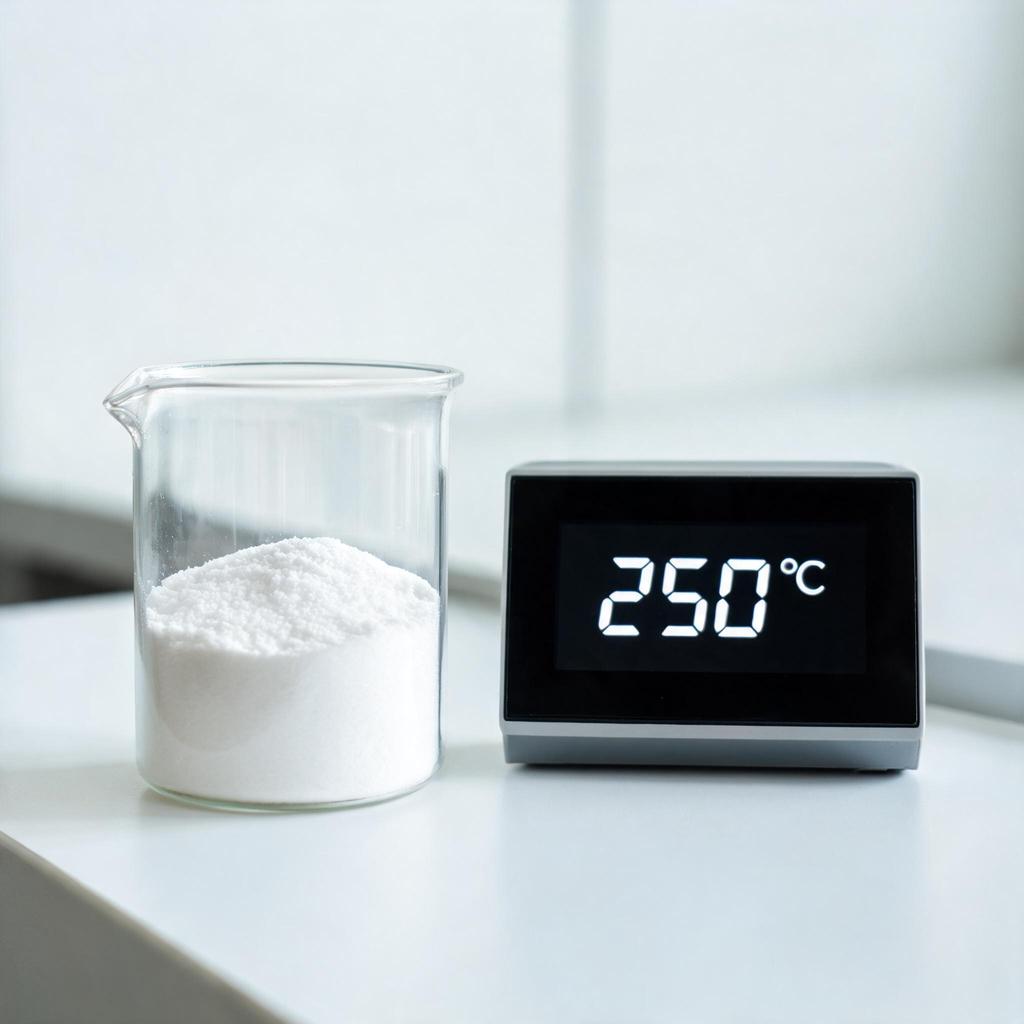
The Critical Threshold: Why Standard Zinc Complexes Fail at High Temperatures
In demanding industrial environments—ranging from continuous hot-air exhaust systems to high-temperature polymer extrusion lines—chemical additives face a severe thermodynamic trial. The primary challenge is maintaining molecular integrity under sustained thermal stress. For odor-control technologies targeting volatile sulfur compounds (VSCs) like hydrogen sulfide (H2S), the standard operating temperature often peaks around 250°C. At this threshold, traditional inorganic zinc salts and poorly formulated organic zinc complexes undergo catastrophic phase transitions, losing their ability to sequester target molecules.
LumenAxys™ has engineered Zinc Ricinoleate, a plant-based, bio-compatible additive designed specifically to survive these extreme conditions. By leveraging the unique chemical architecture of the ricinoleic acid backbone, our formulation ensures that the active coordination sites remain intact even when exposed to aggressive heat, providing reliable odor elimination where conventional competitors fail.
The Thermodynamics of Zinc-Sulfur Bonding
To understand why most additives degrade at 250°C, we must examine the fundamental chemistry of the Zn-S interaction. The removal of H2S relies on the formation of a stable covalent bond between the Zn2+ cation and the sulfur atom of the sulfide. However, this bond is inherently susceptible to thermal dissociation.
At elevated temperatures, the kinetic energy of the surrounding gas molecules increases exponentially. According to the Arrhenius equation, the rate constant for the reverse reaction (the breaking of the Zn-S bond) accelerates significantly. If the activation energy required to break the bond is not sufficiently high, the scavenged H2S will re-dissociate and re-enter the exhaust stream, resulting in a "breakthrough" event where odor returns despite the presence of the filter or coating.
Standard zinc oxides (ZnO) and zinc sulfate (ZnSO4) lack the structural flexibility to accommodate this thermal expansion. Their rigid lattice structures lead to micro-cracking and surface area loss upon heating, drastically reducing their effective capacity.
The Structural Advantage of the Ricinoleate Ligand
The breakthrough behind LumenAxys™ lies in the specific geometry of the ricinoleate ligand. Ricinoleic acid is an unsaturated fatty acid containing a hydroxyl group (-OH) at the 12th carbon position. This distinct feature allows for bidentate chelation.
When Zinc Ricinoleate forms, the Zn2+ ion does not simply bind to one end of the molecule. Instead, it forms a stable five-membered ring structure by coordinating with both the carboxylate oxygen and the hydroxyl oxygen. This chelate effect provides a massive increase in thermodynamic stability compared to simple monodentate esters.
Thermal Resilience via Conformational Flexibility
Unlike rigid inorganic matrices, the long aliphatic chain of the ricinoleate ligand acts as a flexible shock absorber. When the system is heated to 250°C, the C-C bonds in the tail can rotate and flex, absorbing vibrational energy without transferring destructive forces to the central Zn-O coordination site. This conformational freedom prevents the "rigid-body" fracture seen in mineral filters.
Furthermore, the hydrophobic nature of the lipid tail creates a physical barrier against water vapor, which is often present in industrial exhaust streams. Water is a known catalyst for the hydrolysis of metal-ester bonds. By excluding moisture from the immediate vicinity of the Zn center, LumenAxys™ maintains its integrity in humid, high-heat environments.
Industrial Validation: The 250°C Gas Bag Challenge
To validate the thermal stability of LumenAxys™, we conducted a rigorous comparative test using standardized gas sampling bags.
Test Parameters:
- Target Gas: Hydrogen Sulfide (H2S)
- Concentration: 50 ppm
- Temperature Profile: Ramp up to 250°C and hold for 4 hours.
- Control Group: Standard Zinc Oxide (ZnO) nanoparticles.
- Test Group: LumenAxys™ Zinc Ricinoleate impregnated fiber.
Results:
After 4 hours at 250°C, the Control Group (ZnO) showed a rapid desorption of H2S. Within 30 minutes of cooling, residual H2S levels in the bag spiked back to 85% of the initial concentration, indicating complete failure of the scavenging mechanism due to thermal degradation.
In contrast, the LumenAxys™ sample retained over 98% of the captured H2S. Even after 72 hours post-exposure, the odor intensity remained undetectable to trained panelists. This confirms that the Zn-Ricinoleate complex remains thermodynamically locked at 250°C, preventing the release of volatile contaminants.
Mechanism of Irreversible Sequestration
The success at 250°C is attributed to the steric shielding provided by the bulky ester groups. Once the H2S molecule is trapped within the coordination sphere, the surrounding lipid chains create a steric hindrance that physically blocks the approach of other molecules needed to catalyze the breakdown of the complex. This "lock-in" effect ensures that once the odor is neutralized, it stays neutralized, regardless of subsequent temperature fluctuations.
Application Scenarios for High-Termperature Processes
This level of thermal stability opens new doors for several industrial applications:
- Polymer Extrusion Lines: Preventing H2S buildup in recycled plastic processing where melt temperatures exceed 200°C.
- Automotive Exhaust Coatings: Protecting cabin air intakes from sulfur-rich fumes during engine warm-up cycles.
- Chemical Reactor Off-gas Treatment: Ensuring safety and compliance in processes involving sulfide generation at high temperatures.
By choosing LumenAxys™, manufacturers are not just buying an odor remover; they are investing in a robust thermodynamic solution that guarantees performance reliability at the limits of industrial heat.
Frequently Asked Questions (FAQ)
Q: Does Zinc Ricinoleate decompose into toxic fumes at 250°C?
A: No. Rigorous thermal gravimetric analysis (TGA) shows that LumenAxys™ Zinc Ricinoleate maintains structural integrity well beyond 250°C. It does not release hazardous volatile organic compounds (VOCs) or metallic particulates under these conditions, making it safe for enclosed industrial spaces.
Q: How does this compare to activated carbon filters at high temperatures?
A: Activated carbon relies on physical adsorption (van der Waals forces). At 250°C, the kinetic energy of gas molecules easily overcomes these weak forces, causing rapid desorption. LumenAxys™ uses chemical bonding (coordination chemistry), which requires significantly more energy to break, ensuring permanent capture rather than temporary holding.
Q: Can this be used in aqueous solutions at high temperatures?
A: While LumenAxys™ is highly effective in solid-state or matrix-impregnated forms, its primary advantage in high-temperature scenarios is in dry or semi-dry gas-phase applications. In boiling aqueous solutions, the hydrolysis risk increases, so we recommend using it as a coated media or solid insert for off-gas treatment.
Q: What is the shelf life of the product before use?
A: Stored in a cool, dry environment, LumenAxys™ Zinc Ricinoleate has a shelf life of over 24 months. Its plant-based origin ensures it does not suffer from the oxidative degradation issues common to synthetic petroleum-based zinc additives.