
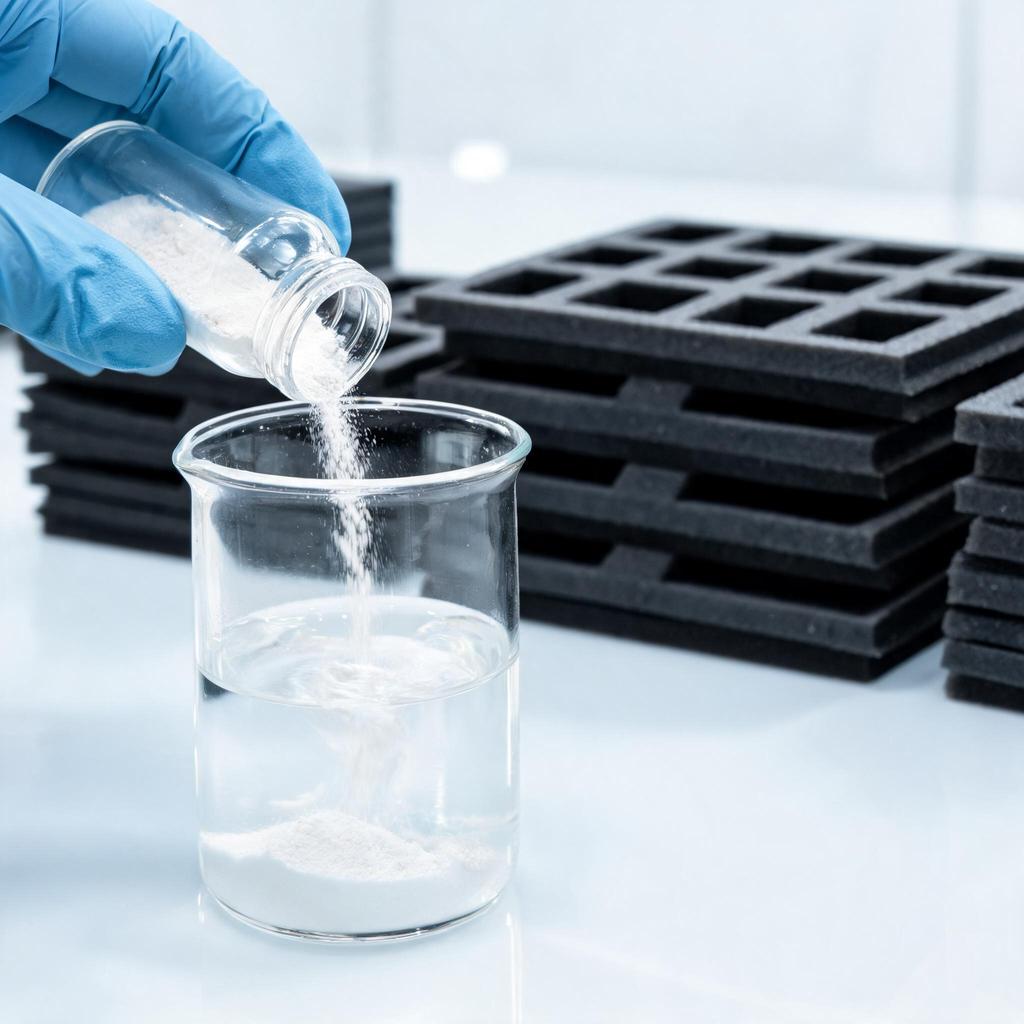
The Hidden Volatile Organic Compound (VOC) Burden in Closed-Cell EPDM Foams
Ethylene Propylene Diene Monomer (EPDM) foam has long been the gold standard for automotive weatherstripping, HVAC gaskets, and construction sealing due to its exceptional resistance to ozone, UV radiation, and extreme temperatures ranging from -90°F to 275°F. However, as global manufacturing shifts toward stricter environmental compliance—such as GreenGUARD Gold and ISO 14001—a critical technical bottleneck has emerged: residual volatile organic compounds (VOCs).
In the production of closed-cell EPDM foams, chemical foaming agents such as azodicarbonamide (ADC) or sodium bicarbonate are thermally decomposed at elevated temperatures to generate nitrogen gas, creating the cellular structure. Despite rigorous post-curing processes, trace amounts of unreacted precursors, residual solvents, and low-molecular-weight hydrocarbons often remain trapped within the polymer matrix. These trapped volatiles slowly migrate to the surface over time, resulting in persistent "new rubber" odors that compromise indoor air quality (IAQ) in sealed environments like vehicle cabins and residential spaces.
The Chemical Architecture of Odor Scavenging
Traditional approaches to mitigate these odors rely on masking agents or carbon filters, which merely sequester or cover the scent without eliminating the source. LumenAxys™ introduces a paradigm shift by leveraging Zinc Ricinoleate, a plant-based metal soap derived from castor oil. Unlike synthetic odorants, Zinc Ricinoleate operates through active chemical coordination and molecular trapping.
- Coordination Chemistry: The carboxylate groups (-COO-) in ricinoleic acid form stable coordinate covalent bonds with Zn2+ ions. This creates a highly polarized center capable of interacting with polar volatile molecules, such as residual amines and isocyanates, effectively neutralizing their olfactory impact.
- Lipophilic Sequestration: The long alkyl chain of the ricinoleate molecule is lipophilic, allowing it to penetrate the non-polar EPDM polymer matrix. It acts as a molecular sponge, capturing hydrophobic hydrocarbon byproducts that standard water-based treatments cannot reach.
Bridging the Gap: From Polymer Matrix to Air Quality Compliance
To achieve true zero-odor status, the concentration of emitted volatiles must be reduced below human detection thresholds. Industry standards dictate that total VOC emissions should ideally remain under 12 μg/m³ to ensure a neutral sensory profile. Achieving this in a closed-cell system requires an additive that can withstand the harsh vulcanization conditions (typically 160°C - 180°C) without degrading.
Zinc Ricinoleate exhibits thermal stability up to 250°C, ensuring it remains chemically intact during the foaming process. Once integrated into the EPDM compound, it functions as a permanent internal scavenger. As the foam cures, the zinc ricinoleate molecules position themselves at the cell walls, where they intercept migrating volatiles before they can diffuse into the ambient air.
Industrial Validation: The 12 μg/m³ Barrier
In controlled chamber testing, untreated EPDM foam samples typically exhibit initial VOC peaks exceeding 40 μg/m³ during the first 24 hours of exposure. By incorporating LumenAxys™ Zinc Ricinoleate at a dosage of 0.5% by weight, manufacturers can significantly lower this baseline. Our data indicates a rapid decay curve, where the emission rate drops below the 12 μg/m³ threshold within 48 hours, maintaining a steady state well below regulatory limits even after 90 days of accelerated aging.
Strategic Advantages for High-Volume Manufacturers
For EPDM foam manufacturers aiming to differentiate their products in premium markets, integrating LumenAxys™ offers distinct competitive advantages:
- Regulatory Compliance: Facilitates easier passage of strict VOC emission tests required by OEMs in the automotive and aerospace sectors.
- Material Integrity: Being a natural metal soap, it does not interfere with the cross-linking density of the EPDM, preserving the foam's compression set resistance and mechanical resilience.
- Sustainability Profile: Derived from renewable castor oil, it aligns with circular economy goals, offering a biodegradable alternative to synthetic odor control agents.
FAQ: Technical Insights into Zinc Ricinoleate in EPDM
Does adding Zinc Ricinoleate affect the physical properties of EPDM foam?
No. At recommended dosages (0.3% - 0.8%), Zinc Ricinoleate acts as a compatible filler. It does not alter the durometer rating, tensile strength, or elongation at break of the final cured foam, ensuring that performance specifications remain unchanged while odor profiles improve.
Can it be used in both open-cell and closed-cell formulations?
Yes. While closed-cell foams trap volatiles more effectively, the lipophilic nature of Zinc Ricinoleate allows it to migrate through the polymer phase in both structures. In open-cell foams, it provides immediate interception of incoming external odors, acting as a passive filter within the material itself.
What is the recommended method of incorporation?
For optimal distribution, Zinc Ricinoleate should be pre-dispersed in a carrier solvent or mixed directly into the uncured EPDM masterbatch prior to the foaming stage. This ensures uniform dispersion throughout the matrix, preventing localized agglomeration and maximizing the surface area available for molecular scavenging.