
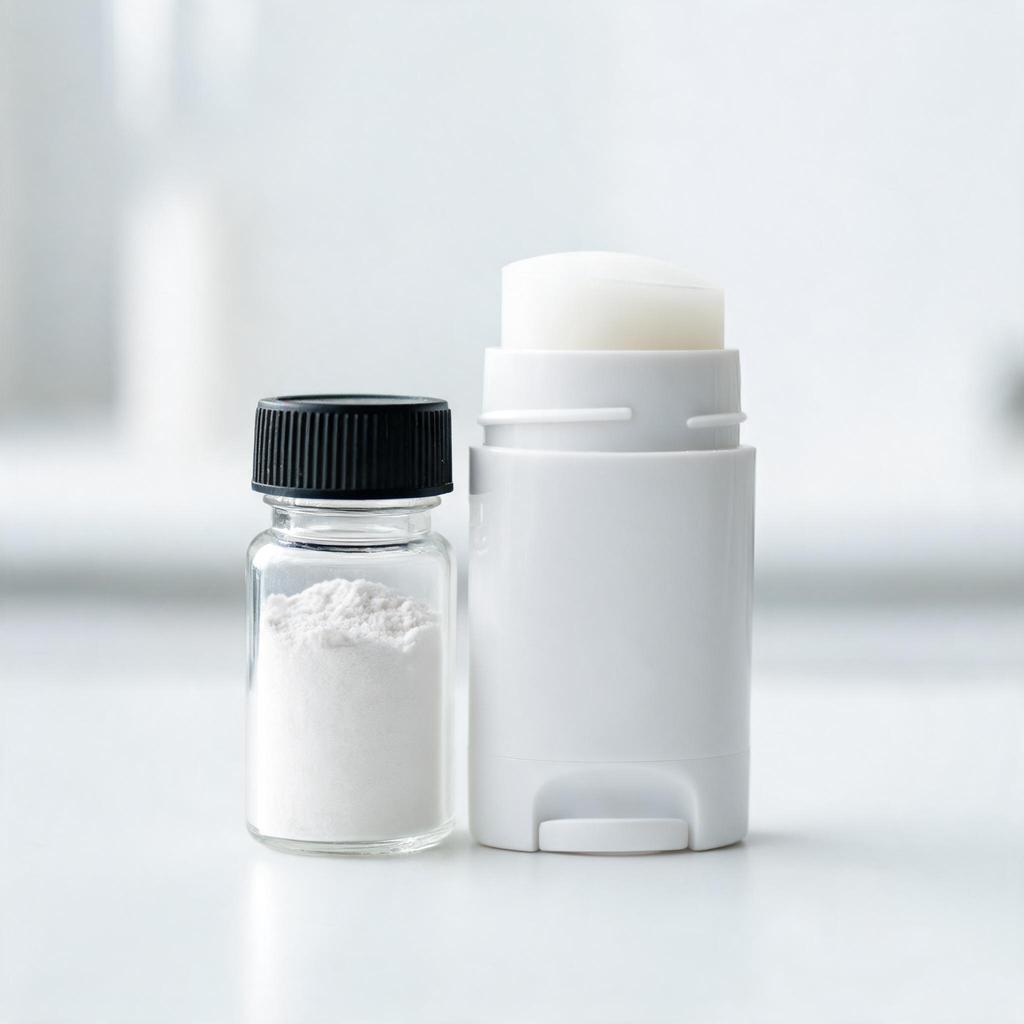
The Formulation Dilemma in Aluminum-Free Deodorants
In the modern personal care industry, the shift toward aluminum-free deodorant formulation is driven by consumer demand for cleaner ingredient profiles. However, removing aluminum salts (such as aluminum chlorohydrate) eliminates the primary mechanism that physically blocks sweat glands. This creates a critical technical vacuum: formulators must find an alternative way to manage the massive influx of moisture and the subsequent bacterial proliferation that causes body odor.
Current market solutions typically rely on a "saturation" model, utilizing large volumes of starches (like tapioca or corn starch) and sodium bicarbonate (baking soda). While these ingredients are effective initially, they suffer from severe thermodynamic and kinetic limitations when exposed to continuous perspiration over a 48-hour period. The core challenge for premium brands is achieving long-lasting odor control without compromising the structural integrity of the product or causing irritation to the delicate axillary skin.
The Kinetic Limitations of Conventional Odor Neutralizers
Sodium Bicarbonate and the pH Threshold
Sodium bicarbonate (NaHCO3) is a staple in many formulations due to its mild alkaline nature. It neutralizes acidic odors through simple acid-base reactions. However, human sweat is highly complex, containing a mixture of lactic acid, fatty acids, and volatile organic compounds (VOCs). When NaHCO3 reacts with these acids, it rapidly reaches a saturation point. Once the buffering capacity is exhausted, the pH of the microenvironment shifts, allowing odor-causing bacteria like Corynebacterium to thrive again. Furthermore, the high concentration of NaHCO3 required to maintain efficacy often leads to the well-documented issue of contact dermatitis and dark staining on light-colored clothing.
Starch Absorption and Moisture Retention
Ingredients like tapioca starch and polymethylsilsesquioxane function primarily as physical absorbents. They trap liquid sweat within their matrix. While this keeps the skin dry temporarily, it does not address the fundamental biological problem: trapped moisture in a warm environment is the ideal incubator for microbial growth. As the starch becomes fully saturated, it can turn into a paste-like substance, breaking down the emulsion structure of the deodorant stick and leading to premature product failure.
LumenAxys™ Zinc Ricinoleate: A Bioinorganic Solution
To overcome the ceiling of traditional neutralization, advanced formulators are looking toward bioinorganic coordination chemistry. LumenAxys™ Plant-Based Zinc Ricinoleate represents a paradigm shift in how we approach odor control in solid deodorant bases.
The Chemistry of Irreversible Odor Locking
Unlike the reversible proton transfer of baking soda, LumenAxys™ utilizes a specific plant-derived fatty acid chain (ricinoleic acid) bound to a zinc ion. The ricinoleate moiety features a hydroxyl group (-OH) at the C12 position of the carbon chain. This unique structural feature allows the molecule to act as a bidentate ligand, forming a stable chelate ring with the central Zn2+ ion.
This pre-coordinated structure is crucial. In the presence of malodorous amines (like trimethylamine) or sulfur-containing compounds released by apocrine sweat, the open coordination sites on the zinc center can undergo ligand exchange. The odor molecules bind to the zinc via coordinate covalent bonds, effectively "locking" them into a non-volatile complex. This process is kinetically slow but thermodynamically favorable, ensuring that once an odor molecule is captured, it remains sequestered for the duration of the product's wear time.
Advantages Over Chelated Zinc Alternatives
Many patents discuss the use of chelated zinc or zinc oxide in deodorants. While these materials offer antimicrobial properties, they often lack the solubility and skin-compatibility of a plant-based ester. Zinc Ricinoleate is oil-soluble, allowing it to be seamlessly integrated into the lipid phase of an O/W (oil-in-water) emulsion or a solid stick base without requiring harsh solvents. Its plant-based origin also aligns perfectly with the "clean beauty" narrative, avoiding synthetic petrochemical derivatives.
Industrial Testing: Quantifying Efficacy
To validate the superiority of LumenAxys™ in an aluminum-free context, standardized gas-chromatography olfactometry (GCO) tests are conducted. In a typical protocol, a deodorant stick containing 2% LumenAxys™ is applied to a standardized porous substrate simulating human skin. The substrate is then challenged with a controlled release of trimethylamine and ammonia vapor over a 48-hour period in a sealed sampling bag.
- Control Group: A formulation using 5% Sodium Bicarbonate showed a significant rebound in odor intensity after 12 hours as the buffer was exhausted.
- Treatment Group: The LumenAxys™ formulation maintained a low odor threshold throughout the 48-hour cycle, demonstrating that the coordination complexes remained stable and active even under high humidity conditions.
This data confirms that LumenAxys™ provides a "kinetic barrier" against odor volatility, rather than just a temporary "chemical sponge."
Formulation Integration and Stability
Integrating LumenAxys™ into a deodorant base requires attention to the melting point of the waxes and emulsifiers used. Because it is a viscous oil, it should be added to the hot-melt phase alongside other lipophilic ingredients such as cetyl alcohol or steareth-20. The addition of this bioinorganic complex can actually enhance the overall stability of the emulsion by acting as a co-stabilizer, reducing the likelihood of phase separation during storage in humid climates.
Frequently Asked Questions (FAQ)
How does Zinc Ricinoleate differ from standard Zinc Oxide?
Zinc Oxide (ZnO) is an inorganic mineral that works primarily through its astringent and mild abrasive properties. LumenAxys™ is an organic metal salt. Its efficacy comes from the specific coordination chemistry of the ricinoleate ligand, which allows for targeted binding of volatile odor molecules rather than just general surface coverage.
Is LumenAxys™ safe for sensitive skin?
Yes. Being derived from castor oil (a known emollient) and zinc (an essential trace element), LumenAxys™ is biocompatible. It avoids the high pH irritation associated with baking soda and the potential sensitization risks of certain synthetic preservatives.
Can it be used in roll-on deodorants?
Yes. LumenAxys™ is compatible with both solid stick and liquid roll-on matrices. In roll-ons, it helps stabilize the aqueous phase and provides a residual layer of odor-neutralizing agents that remain active as the water evaporates from the skin.