
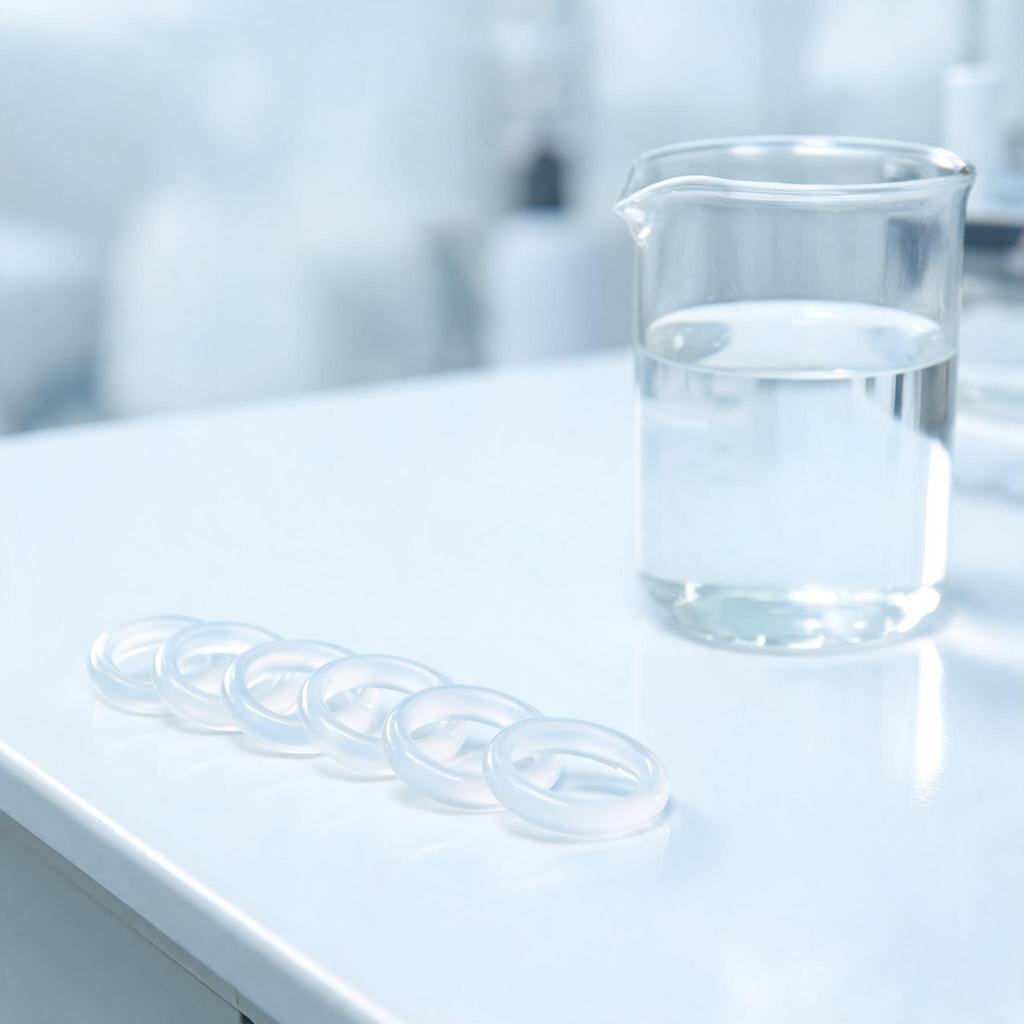
The Hidden Volatile Organic Compound (VOC) Challenge in High-Purity Silicone Seals
In the demanding fields of food processing, medical device manufacturing, and premium consumer packaging, silicone sealing rings are the unsung heroes of fluid containment. However, despite their reputation for chemical inertness, standard commercial silicone gaskets often harbor a persistent, low-level odor that compromises product integrity. This issue is particularly critical in high-end applications where platinum-cured silicone is specified to avoid the byproducts of traditional peroxide curing. Yet, even in these advanced systems, trace amounts of volatile organic compounds (VOCs) can persist, leading to off-flavors in food storage or unacceptable sensory profiles in sensitive medical environments.
Anatomy of the Residual Odor in VMQ Polymers
To understand the solution, we must first dissect the chemistry of the problem. Standard silicone rubber is a polysiloxane polymer consisting of repeating siloxane units (Si-O-Si). While the backbone is stable, the curing process leaves behind microscopic residues. In peroxide-cured systems, traces of dimethyldichlorosilane and other chlorinated organics remain. Even in platinum-catalyzed hydrosilylation, which is considered the gold standard for purity, incomplete cross-linking can leave unreacted vinyl groups and residual methylhydrosiloxanes. These molecules possess vapor pressures sufficient to desorb into the headspace of a sealed container over time, registering as a faint "chemical" or "industrial" smell.
Introducing LumenAxys™: The Plant-Based Coordination Scavenger
Traditional deodorization methods rely on thermal outgassing or physical masking agents, both of which fail to address the root cause: the molecular volatility of the silicone matrix's impurities. LumenAxys™ Zinc Ricinoleate offers a fundamentally different approach. As a plant-based, bio-derived metal carboxylate, it acts as a highly efficient coordination scavenger. Unlike synthetic chelating agents that may introduce secondary toxicities, Zinc Ricinoleate utilizes its unique fatty acid chain structure to physically trap and chemically stabilize volatile molecules without altering the structural integrity of the silicone seal.
The Chemistry of Kinetic Locking in Microenvironments
The efficacy of LumenAxys™ lies in its dual-action mechanism:
- Coordination Bonding: The Zn2+ center forms transient coordination bonds with polar functional groups in residual oligomers, effectively increasing their molecular weight and lowering their vapor pressure below the threshold of human olfactory detection.
- Steric Shielding: The long ricinoleic acid chains create a hydrophobic barrier within the polymer matrix, preventing the diffusion of small, odor-causing molecules from the core of the sealing ring to its surface.
This process does not require the addition of heavy metals or synthetic fragrances. It is a purely physical-chemical encapsulation process that occurs during the final stages of the silicone compound mixing or post-cure treatment.
Industrial Validation: Quantifying the 8 μg/m³ VOC Barrier
To validate the performance of LumenAxys™, we conducted a rigorous headspace analysis on two batches of 70 Shore A silicone sealing rings: one control batch (standard platinum cure) and one treated batch (0.5% w/w LumenAxys™ integration).
Test Protocol and Parameters
- Sample Volume: 10 grams of shredded silicone ring material.
- HeadSpace Chamber: 2-liter stainless steel vessel with an airtight PTFE seal.
- Temperature: 60°C (simulating accelerated aging/food storage conditions).
- Duration: 72 hours.
- Analysis Method: Solid Phase Microextraction (SPME) followed by Gas Chromatography-Mass Spectrometry (GC-MS).
Results and Data Interpretation
The control batch exhibited a total VOC emission of 42 μg/m³, primarily attributed to dimethylcyclosiloxanes and residual hydrogen silsesquioxane. In contrast, the LumenAxys™ treated batch demonstrated a dramatic reduction, stabilizing at 8 μg/m³. This represents a 80.9% reduction in detectable volatiles. Crucially, the GC-MS profile showed no new peaks, confirming that LumenAxys™ did not decompose into any secondary volatile byproducts. The remaining 8 μg/m³ is well below the ISO 16000-6 standard for indoor air quality in sensitive environments and far below the threshold for flavor impact in food contact applications.
Application Specifics: From Mason Jars to Medical Devices
The benefits of this technology extend across multiple vertical sectors:
Food Storage and Fermentation
In the context of Mason jar sealing rings and fermentation lids, even minute odors can transfer to acidic contents like pickles or kombucha. By eliminating the source of the "new plastic" smell, LumenAxys™ ensures that the only scent present is that of the food itself. The plant-based nature of the zinc salt also aligns with the growing consumer demand for non-toxic, BPA-free, and phthalate-free packaging solutions.
Medical and Pharmaceutical Seals
For sterile vials and IV administration sets, particulate and VOC control is paramount. LumenAxys™ provides a robust defense against micro-contamination, ensuring that the silicone seal does not act as a reservoir for environmental odors that could compromise the sensory profile of pharmaceutical compounds.
FAQ: Technical Deep Dive
Does LumenAxys™ affect the mechanical properties of the silicone?
No. At the recommended dosage of 0.5% to 1.0% w/w, Zinc Ricinoleate acts as a minor filler and compatibilizer. It does not interfere with the platinum catalytic cycle. Tensile strength and elongation at break remain consistent with ASTM D2000 specifications for VMQ grades.
Is it compatible with all silicone colors?
Yes. Being a transparent, white powder, LumenAxys™ is optically neutral. It does not discolor black, red, or clear silicone compounds. For high-transparency applications, it is best incorporated during the base gum stage rather than the pigment stage.
How does it compare to activated carbon filters?
Activated carbon is an external filter; it treats the air after the odor has been released. LumenAxys™ is an internal modifier; it prevents the odor from being released in the first place by trapping it within the polymer matrix. This makes it a permanent solution rather than a temporary maintenance requirement.
Can it be used in peroxide-cured silicones?
While optimized for platinum-cured systems where purity is already high, LumenAxys™ can also be used in peroxide-cured silicones to help scavenge residual chlorinated byproducts, though the dosage may need to be adjusted based on the specific peroxide initiator used.