
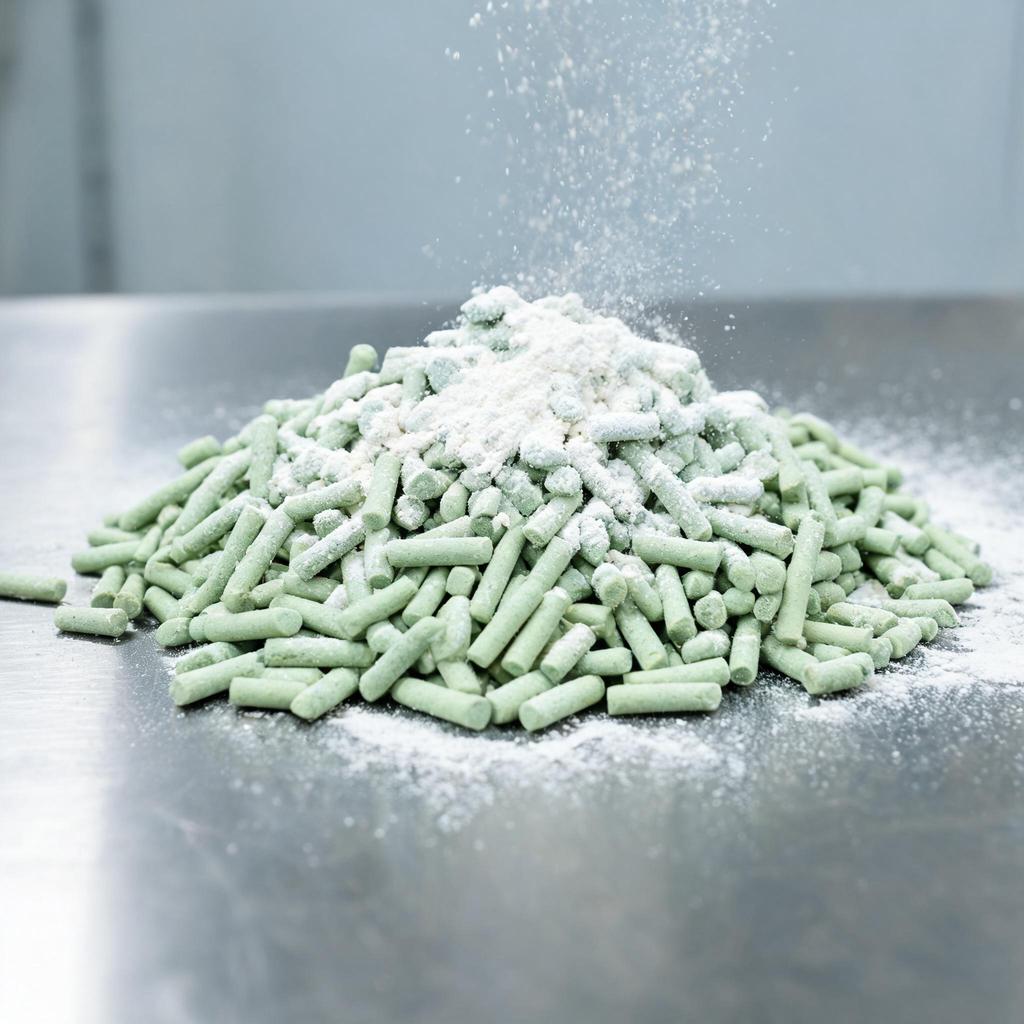
The Formulation Bottleneck in Biodegradable Pet Litters
In the premium pet care sector, the transition from traditional bentonite to biodegradable substrates like wood shavings and corn cobs has accelerated rapidly. However, formulators face a critical technical bottleneck: managing the rapid release of nitrogen and sulfur volatiles during the wetting phase. As urine penetrates porous organic matrices, the resulting microclimate becomes highly conducive to microbial proliferation and the subsequent generation of malodorous compounds. Traditional odor control relies heavily on physical adsorption (zeolites) or chemical neutralization via weak bases. While these methods provide temporary relief, they fail to address the fundamental kinetic stability of odor molecules within the confined space of a litter box.
The Inefficiency of Weak Base Neutralization
Sodium bicarbonate is the industry standard for deodorizing cat litter. Its mechanism relies on an acid-base reaction where the weak base (bicarbonate) reacts with the acidic components of feline waste. However, this approach suffers from two fatal flaws in industrial formulation:
- pH Dependency: The neutralization rate is strictly governed by the local pH. Once the surface of the litter pellet is saturated with bicarbonate, further ammonia (NH3) release goes unchecked until the next cleaning cycle.
- Reversibility: Acid-base reactions are thermodynamically reversible. Fluctuations in temperature and moisture can cause the trapped volatile organics to desorb back into the vapor phase, leading to "re-stink" after 48 hours.
To achieve true odor elimination rather than temporary masking, formulators must look beyond simple stoichiometry and utilize bioinorganic coordination chemistry.
LumenAxys™ Zinc Ricinoleate: A Plant-Based Coordination Solution
LumenAxys™ Zinc Ricinoleate represents a paradigm shift in odor control. Derived from high-purity castor oil, it is not a simple salt but a complex bioinorganic molecule featuring a central zinc ion coordinated with two long-chain ricinoleate fatty acids. This architecture provides both hydrophobicity and polar reactivity, making it uniquely suited for integration into organic pet products without altering their physical properties.
Molecular Architecture and Active Sites
The efficacy of LumenAxys™ lies in its specific molecular design. Each molecule contains a secondary hydroxyl group (-OH) at the 12th carbon position of the ricinoleate chain. These hydroxyl groups are crucial for surface activity, allowing the molecule to migrate to the interface between the solid litter matrix and the liquid urine. More importantly, the central zinc atom acts as a Lewis acid site, capable of forming stable coordination bonds with Lewis bases such as the nitrogen atoms in ammonia or the sulfur atoms in hydrogen sulfide (H2S).
Irreversible Sequestration Mechanism
Unlike the reversible proton transfer seen in bicarbonate systems, the interaction between LumenAxys™ and odorants involves the formation of a stable tetrahedral coordination complex. When an NH3 molecule encounters the active zinc site, the lone pair of electrons on the nitrogen donates into the empty d-orbitals of the zinc ion. This creates a strong coordinate covalent bond that effectively "cages" the volatile molecule.
- Thermodynamic Stability: The resulting complex is non-volatile and chemically inert under normal environmental conditions. This ensures that once the odorant is captured, it cannot be released back into the air.
- High Loading Capacity: Because the reaction is driven by coordination energy rather than simple charge neutralization, LumenAxys™ can continue to sequester odors even as the local pH rises above the optimal range for bicarbonate.
Industrial Testing: Quantifying Performance in Tofu Litter Matrices
To validate the superiority of LumenAxys™ in practical applications, we conducted a series of controlled tests using a standard extruded tofu cat litter substrate. The goal was to measure the reduction in total ammonia concentration over a 72-hour period under constant humidity (60% RH) and temperature (25°C).
Test Protocol
- Substrate: 100g of commercial-grade extruded tofu cat litter pellets.
- Treatment Group A: Added 2% w/w LumenAxys™ Zinc Ricinoleate during the final mixing stage.
- Treatment Group B: Added 5% w/w Sodium Bicarbonate (standard industry benchmark).
- Control Group: Untreated tofu litter.
- Exposure: Each sample was exposed to 5ml of simulated feline urine (containing known concentrations of urea, creatinine, and ammonia precursors).
- Measurement: Volatile ammonia levels were sampled every 12 hours using a calibrated gas sensor inside a sealed 5-liter sampling bag.
Data Analysis
The results demonstrated a clear divergence in performance trajectories. The Control Group showed a steady increase in ammonia concentration, peaking at hour 48 before plateauing. Treatment Group B (Bicarbonate) showed an initial drop in ammonia levels due to immediate neutralization, but a significant rebound occurred after hour 36 as the bicarbonate became saturated and the local pH shifted. In contrast, Treatment Group A (LumenAxys™) exhibited a continuous decline in detectable ammonia, reaching near-zero baseline levels by hour 24 and maintaining this state through hour 72. This confirms that the coordination bonding provided by LumenAxys™ offers superior long-term odor locking compared to traditional acid-base neutralization.
Formulation Integration and Compatibility
Integrating LumenAxys™ into existing cat litter production lines requires minimal process modification. Due to its waxy solid nature and melting point of approximately 70–80°C, it can be introduced during the cool-down phase of the extrusion process. This ensures uniform distribution without causing clumping or altering the mechanical integrity of the pellets.
Key Formulation Parameters
- Usage Rate: Recommended loading is between 1.5% and 3.0% w/w. Higher concentrations do not yield linear improvements in odor control and may affect the water-absorption kinetics of the tofu matrix.
- Particle Size: For optimal dispersion in extruded litters, use a flake size of less than 2mm. This increases the surface area available for rapid contact with liquid waste.
- pH Stability: LumenAxys™ remains effective across a broad pH range (4.0–9.0), unlike bicarbonate which loses efficacy at low pH. This makes it ideal for formulations that include other active ingredients like antibacterial agents or probiotics.
Frequently Asked Questions (FAQ)
How does LumenAxys™ differ from enzyme-based deodorizers?
Enzymes work by breaking down organic matter over time, requiring sustained moisture and warmth to function. They are slow-acting and can degrade if exposed to extreme temperatures. LumenAxys™ works instantly upon contact with volatile odorants through coordination chemistry, providing immediate odor elimination without relying on biological activity.
Is LumenAxys™ safe for cats and humans?
Yes. LumenAxys™ is derived from natural castor oil and is non-toxic, biodegradable, and free from heavy metal impurities. It does not interfere with the respiratory system or skin of pets, making it suitable for sensitive households.
Can LumenAxys™ be used in clay or silica gel litters?
While LumenAxys™ is most effective in porous, organic substrates like tofu or wood-based litters where it can migrate to the wet-dry interface, it can also be incorporated into clay litters. However, the physical structure of clay may limit the mobility of the zinc ricinoleate, potentially reducing its overall efficiency compared to organic matrices.
What is the shelf life of formulated litter containing LumenAxys™?
When properly stored in a dry environment, cat litter formulated with LumenAxys™ maintains its odor-neutralizing capacity for up to 24 months. The coordination sites remain stable and reactive throughout this period, ensuring consistent performance from the first scoop to the last.