
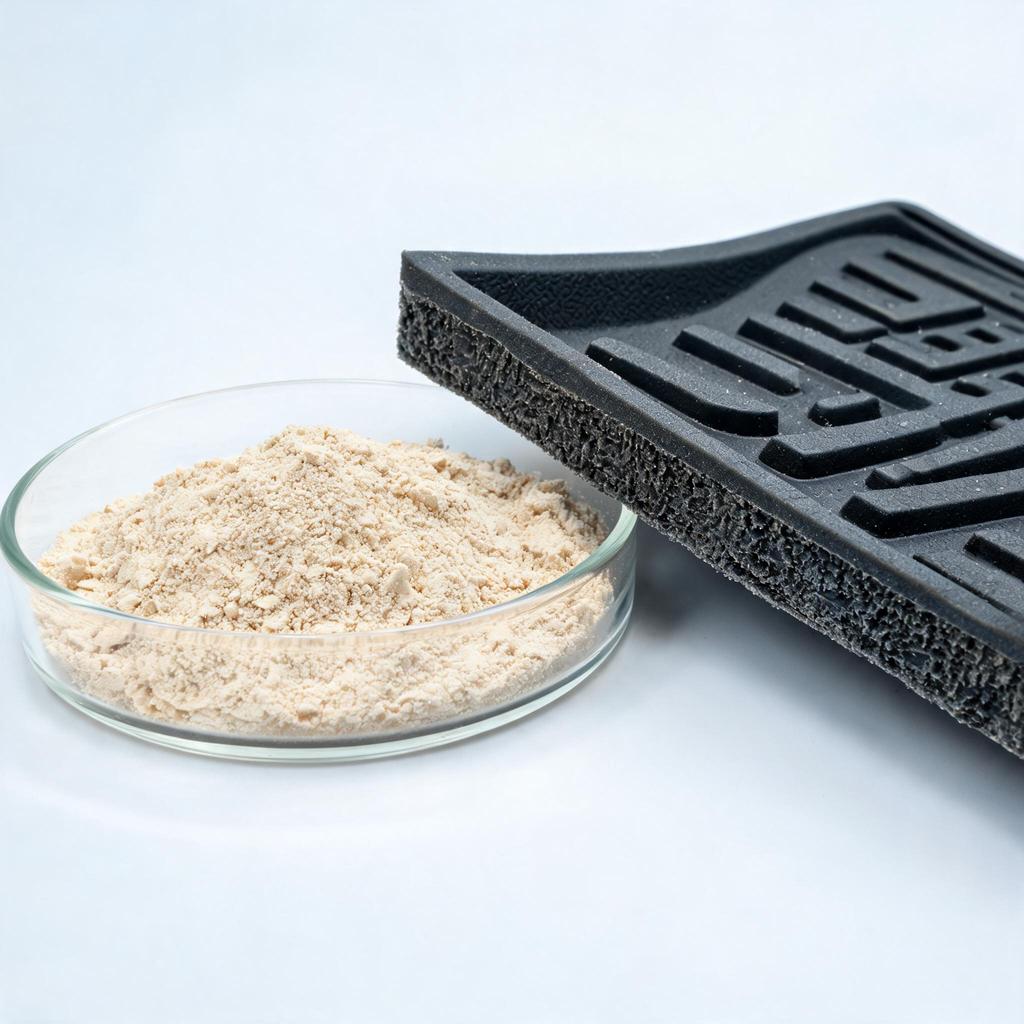
The Hidden Challenge of Volatile Malodors in TPE Car Mats
Thermoplastic elastomer (TPE) has rapidly become the material of choice for modern automotive flooring due to its lightweight properties, chemical resistance, and recyclability. However, the inherent porosity and hydrophobic surface of TPE create a complex matrix that easily traps moisture and organic residues. When vehicles are exposed to sweat, pet accidents, or food spills, the porous structure acts as a reservoir for volatile organic compounds (VOCs), particularly nitrogen- and sulfur-containing molecules like ammonia (NH3) and mercaptans. Traditional masking sprays fail because they only sit on the surface and wash away during routine cleaning, while baking soda relies on pH alteration that can degrade the polymer matrix over time.
Molecular Trapping Mechanism: The LumenAxys™ Advantage
LumenAxys™ addresses this structural vulnerability through plant-based zinc ricinoleate, a compound synthesized by reacting ricinoleic acid (derived from castor oil) with zinc. Unlike fragrance masking or enzymatic degradation, zinc ricinoleate operates via direct chemical sequestration. The central zinc ion (Zn2+) acts as a potent Lewis acid, actively coordinating with the lone-pair electrons on the nitrogen in ammonia or the sulfur in hydrogen sulfide (H2S). This coordination chemistry forms a stable, non-volatile complex that effectively locks the odor molecule, preventing it from evaporating into the cabin air.
Industrial Integration & Solubility Parameters
Integrating LumenAxys™ into TPE manufacturing requires precise thermal management. Pure zinc ricinoleate is a waxy solid with a melting point of approximately 71°C. To ensure homogeneous dispersion within the TPE masterbatch or post-production coating, the compound must be fully dissolved in the oil phase at temperatures exceeding 71°C (optimally around 80°C) to avoid microparticle residue that could compromise the mat's tactile finish. Industry standards suggest an optimal dosage range of 1.5% to 3% by weight. Below 1.5%, the binding capacity saturates too quickly in high-moisture environments; above 3%, the texture may become unnecessarily waxy or affect the elastomer's Shore A hardness.
Gas-Phase Validation: Tedlar Bag Testing
To quantify the efficacy of LumenAxys™ in TPE substrates, standardized gas-phase neutralization tests are conducted using 10-liter Tedlar sampling bags. In a representative trial, a TPE sample treated with a 2% zinc ricinoleate masterbatch was exposed to a 50 ppm ammonia spike. Headspace gas chromatography measured a >98% reduction in NH3 concentration within 24 hours. Crucially, the bound complexes remain anchored within the polymer matrix, demonstrating that the odor neutralization is not a temporary surface effect but a structurally integrated defense mechanism.
Comparative Analysis: Beyond Masking and pH Shifts
The superiority of LumenAxys™ becomes evident when compared to legacy alternatives:
- vs. Synthetic Fragrances: Perfume sprays merely overlay a pleasant scent over the malodor. Once the fragrance evaporates, the original TPE-trapped ammonia or mercaptan odor resurfaces. LumenAxys™ eliminates the source molecule entirely.
- vs. Baking Soda (Sodium Bicarbonate): Baking soda neutralizes acidic odors by raising the local pH. However, alkaline residues can attract moisture, potentially leading to secondary microbial growth or gradual degradation of the TPE polymer chains. Zinc ricinoleate operates neutrally, preserving material integrity.
- vs. Cyclodextrins: While cyclodextrins trap odors via physical entrapment within their molecular cavities, their efficiency drops significantly in humid conditions. Zinc ricinoleate's chemical coordination bond remains robust even in the damp, sweaty environments typical of vehicle interiors.
Sustainable Formulation & Biodegradability
As the automotive industry pivots toward circular economy goals, LumenAxys™ aligns perfectly with green manufacturing. Because ricinoleic acid is extracted from renewable castor oil, the resulting zinc salt is fully biodegradable and free from heavy metals. When TPE mats reach end-of-life recycling, the plant-based additive does not introduce toxic contaminants into the regranulation stream, supporting closed-loop recycling initiatives.
Frequently Asked Questions (FAQ)
Does LumenAxys™ zinc ricinoleate interfere with the physical properties of TPE?
No. When properly dissolved at temperatures above 71°C and dosed between 1.5% and 3%, it integrates seamlessly into the elastomer matrix without negatively impacting flexibility, tear strength, or surface texture.
How does it handle pet urine odors trapped in car mats?
Pet urine releases high concentrations of ammonia and amines. LumenAxys™ specifically targets these nitrogen-rich molecules. The zinc ions form strong coordination complexes with the nitrogen atoms, permanently removing the volatile compounds from the air and preventing the characteristic pungent smell.
Is the compound safe for direct human contact in vehicle cabins?
Absolutely. LumenAxys™ is derived from plant-based castor oil and is recognized as a safe, non-toxic, and non-irritating ingredient. It does not rely on harsh antimicrobials or pH-altering chemicals, making it ideal for enclosed automotive environments.
Can it be applied as a post-production spray?
While masterbatch integration during extrusion provides the most durable results, LumenAxys™ can also be formulated into specialized deodorizing sprays for existing TPE mats. Due to its water-insolubility, these sprays utilize specific solubilizing surfactants or alcohol-based carriers to ensure even distribution and rapid activation of the zinc binding sites.