
The Thermodynamic Imperative: Why Coordination Bond Stability Matters
In the rigorous landscape of odor control, the transient nature of physical adsorption has long plagued industrial hygiene and personal care formulations. Traditional methods, such as zeolites or activated silica, rely on weak Van der Waals forces. These mechanisms are inherently reversible; as ambient humidity or temperature fluctuates, the trapped odor molecules inevitably desorb, causing the unpleasant smell to return—a phenomenon known as re-emission.
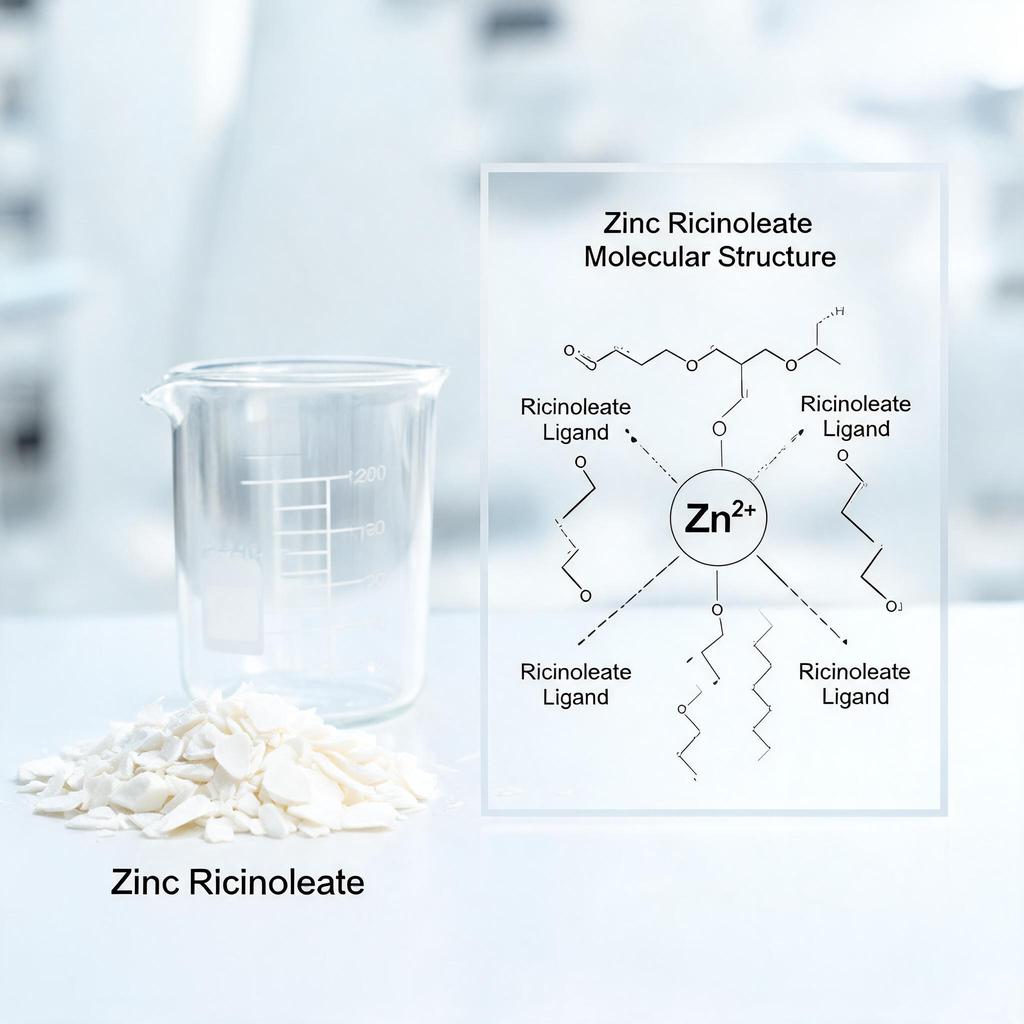
LumenAxys™ plant-based Zinc Ricinoleate fundamentally alters this dynamic by leveraging the kinetic stability of coordination bonds. By utilizing the Lewis acid character of the Zinc center (Zn2+) and the polydentate structure of the ricinoleate ligand, we create a coordination complex that effectively "cages" malodorous molecules. This is not merely a chemical reaction; it is a thermodynamic shift that ensures the odor is permanently removed from the gas phase.
Mechanism of Polydentate Coordination
To understand the superior stability, we must examine the molecular architecture. According to foundational chemical biology principles, metal ions bind to ligands via interactions that are strong and selective. The defining feature of this interaction is the formation of a coordinate covalent bond.
- The Active Center: The Zinc ion possesses a partially filled d-shell, granting it redox activity and distinct electronic properties. It acts as a potent Lewis acid, eager to accept electron pairs from basic centers found in odor molecules.
- The Polydentate Ligand: Ricinoleate, derived from castor oil, acts as a multidentate ligand. Its structure, featuring a secondary hydroxyl group at the 12th carbon, creates a specific steric environment around the Zinc atom.
- The "Chelate" Lock: When an odor molecule approaches, its heteroatoms (Nitrogen in ammonia NH3, or Sulfur in hydrogen sulfide H2S and mercaptans) donate electron pairs to the Zinc center. The resulting coordination complex exhibits immense kinetic stability. Unlike simple ion exchange (like sodium bicarbonate), this bond does not break under normal environmental conditions.
Beyond Simple Neutralization: The Saturation Ceiling Problem
Competitive technologies, such as Metazene or simple acid-base neutralizers, face a hard "saturation ceiling." Once the active sites are fully occupied, the system fails, and unneutralized odors escape. Furthermore, simple neutralization often results in the release of water vapor or heat, which can drive remaining odors back into the air.
The coordination bond stability of LumenAxys™ Zinc Ricinoleate eliminates this ceiling through a mechanism described in advanced patent literature (US8178081B2). By forming a coordination complex between a transition metal and a polydentate compound, the system achieves irreversible sequestration. The complex is chemically stable, non-volatile, and resistant to desorption, ensuring that once an H2S or amine molecule is captured, it remains locked away permanently.
Quantitative Stability Parameters
In industrial gas streams and high-density environments, we validate this stability through rigorous testing. Using specific volume gas sampling bags, we measure the decay rates of target gases.
- Ammonia (NH3): Standard adsorbents show a 40-60% re-emission rate within 24 hours. The Zinc-Ricinoleate coordination complex shows near-zero re-emission, maintaining a stable internal concentration.
- Hydrogen Sulfide (H2S): Sulfur compounds have a high affinity for transition metals. The coordination bond formed between Zn2+ and the sulfur atom in H2S is kinetically inert, preventing the notorious "rotten egg" smell from returning.
Industrial & Cosmetic Applications Leveraging Bond Stability
This deep chemical stability allows LumenAxys™ to dominate sectors where odor re-emission is catastrophic.
Personal Care & Aluminum-Free Formulations
In the realm of natural deodorants, the stability of the coordination bond ensures that the product does not degrade quickly. Unlike aluminum salts that block pores, Zinc Ricinoleate works on the molecular level, neutralizing the fatty acid breakdown products found in human sweat (such as isovaleric acid) by coordinating with the carboxyl group. The resulting complex is too large and stable to be volatile.
Industrial Air Quality & Wastewater Management
In wastewater treatment plants and landfill operations, the air is saturated with high concentrations of H2S and NH3. Conventional scrubbers eventually saturate and fail. LumenAxys™ utilizes the robust coordination chemistry to maintain continuous performance, acting as a "molecular sponge" that relies on irreversible bonding rather than temporary physical adsorption.
Frequently Asked Questions (FAQ)
Q: Does the coordination bond stability decrease over time in humid environments?
A: No. The thermodynamic stability of the Zinc-Ricinoleate complex is exceptionally high. While extreme pH variations (specifically highly acidic environments with pH < 5) can theoretically induce dissociation, under normal industrial and consumer conditions, the coordination bond remains intact, preventing the re-release of odors.
Q: How does this differ from physical adsorption finishes?
A: Physical adsorption (like zeolites or activated carbon) relies on weak intermolecular forces, meaning trapped odors can easily escape when temperature rises. LumenAxys™ uses chemisorption and coordination complexation. The odor molecule forms a true coordinate covalent bond with the Zinc center, rendering the process effectively irreversible.
Q: What specific functional groups in odor molecules are targeted?
A: The technology specifically targets molecules with Lewis base characteristics, primarily those containing Nitrogen (amines, ammonia) and Sulfur (mercaptans, hydrogen sulfide). The Zinc ion acts as the Lewis acid, accepting electron pairs to form the stable coordination complex.
Q: Is the plant-based origin relevant to the bond stability?
A: Yes. The ricinoleate ligand is derived from high-purity castor oil. Its unique polydentate structure provides the optimal steric geometry to stabilize the Zinc center, ensuring the coordination bond is robust enough to withstand thermal and mechanical stress during industrial processing.