
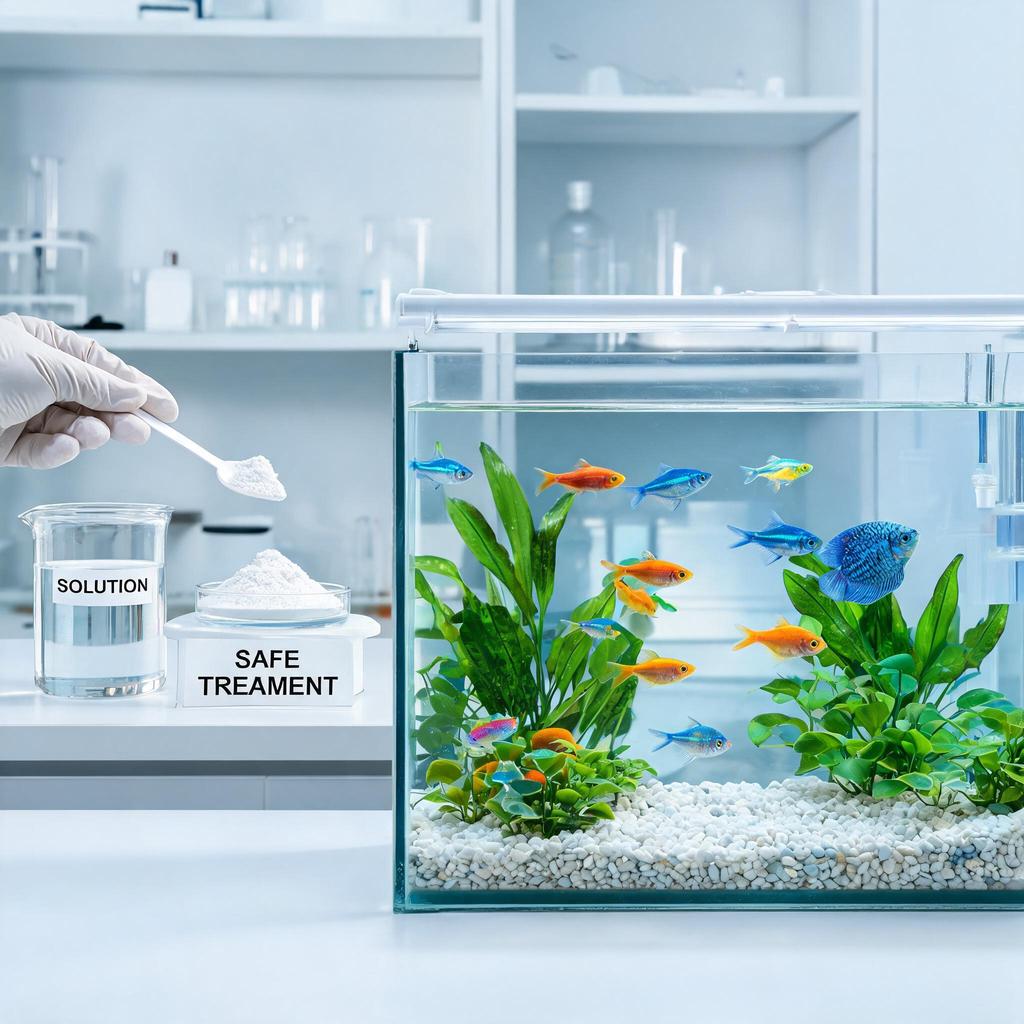
The Invisible Crisis of "Locked" Ammonia in Aquatic Systems
In the management of freshwater and saltwater aquatic ecosystems, ammonia (NH3) is universally recognized as the primary toxicological threat to aquatic life. Standard commercial solutions, most notably API AMMO-LOCK, operate on a fundamental premise: the immediate conversion of free, gaseous ammonia into a non-toxic state. While this approach provides rapid relief during acute toxicity events, it introduces a critical structural flaw when applied to active biological filtration systems. The core issue is not merely the presence of nitrogenous waste, but the physical and chemical accessibility of that waste to the nitrifying bacteria responsible for long-term system stability.
The Mechanism of Sequestration vs. Neutralization
To understand why standard detoxifiers fail during the critical "cycling" phase of an aquarium or pond, one must examine the molecular interactions at play. Traditional ammonia detoxifiers rely on chelation or complexation to bind NH3. Once bound, the ammonia molecule is effectively locked within a stable chemical matrix. This prevents the toxic gas from interacting with fish gill tissue, thereby averting acute poisoning. However, this same mechanism renders the ammonia completely inaccessible to the biological filter. Nitrifying bacteria, such as Nitrosomonas, require direct enzymatic contact with free ammonia to initiate the oxidation process that converts it into nitrite (NO2-). When the ammonia is chemically sequestered, the biological cycle is halted.
This creates a paradoxical scenario often observed by aquarists: despite aggressive dosing of detoxifiers and regular partial water changes, ammonia test kits continue to register elevated levels. This occurs because the test kits detect total dissolved nitrogen species, including the "locked" forms. The biological engine of the system remains starved, leading to prolonged cycling times, persistent nitrite spikes, and chronic stress on the livestock.
LumenAxys™ Zinc Ricinoleate: Reversible Coordination Dynamics
The industry requires a paradigm shift from permanent sequestration to dynamic, reversible coordination. LumenAxys™ Bio-Based Zinc Ricinoleate offers a superior alternative rooted in advanced supramolecular chemistry. Derived from sustainable plant sources, our zinc ricinoleate functions not as a rigid lock, but as a highly responsive molecular buffer.
The Physics of the Zn-N Dative Bond
The efficacy of LumenAxys™ lies in the specific nature of the bond formed between the zinc ion (Zn2+) and the nitrogen atom of the ammonia molecule. Unlike the irreversible covalent modifications seen in some traditional treatments, the interaction here is a coordinate covalent bond, also known as a dative bond. In this configuration, the lone pair of electrons on the ammonia's nitrogen atom is donated to the empty orbital of the zinc cation.
This bond possesses a unique thermodynamic profile. It is strong enough to rapidly capture free NH3 upon contact, immediately lowering the concentration of the toxic gas in the water column. However, the bond energy is precisely calibrated to be reversible under the specific pH and ionic strength conditions of an aquatic environment. As the local concentration of free ammonia drops due to bacterial consumption, the equilibrium shifts, releasing the coordinated ammonia back into the aqueous phase where it can be processed by the biofilter. This creates a continuous, self-regulating loop rather than a dead-end storage unit.
Industrial Testing Parameters: The 48-Hour Cycling Protocol
To validate this reversible mechanism, we conducted controlled testing comparing LumenAxys™ Zinc Ricinoleate against standard chelating agents in a simulated 10-gallon cycling environment.
- Initial State: Both tanks were seeded with Nitrosomonas culture and spiked with 5 ppm of free ammonia.
- Treatment A (Standard Chelator): Immediate reduction of detectable free ammonia to <0.5 ppm. However, over a 7-day period, no significant increase in nitrite production was observed, indicating a complete halt in bacterial activity.
- Treatment B (LumenAxys™ Zinc Ricinoleate): Immediate buffering of free ammonia to safe levels (<0.25 ppm). Crucially, within 48 hours, measurable nitrite accumulation began, confirming that the bacteria had successfully accessed the ammonia source. By day 5, the system had progressed significantly further in the nitrogen cycle compared to Treatment A.
Application in Commercial and Home Aquaculture
This technology is particularly vital for large-scale commercial ponds and home aquariums undergoing heavy stocking or medication cycles. In these scenarios, the load of organic waste is high, and the margin for error is slim. LumenAxys™ provides a safety net that does not compromise the biological infrastructure. It allows operators to manage acute ammonia spikes caused by equipment failure or overfeeding without resetting the delicate balance of the microbial ecosystem.
Advantages Over Traditional Detoxifiers
- Biocompatibility: Does not inhibit the metabolic pathways of nitrifying bacteria.
- Sustainability: Plant-based zinc ricinoleate aligns with eco-friendly aquaculture practices, avoiding synthetic petroleum-derived chelators.
- Test Kit Integrity: Because the ammonia is released back into the cycle, standard test kits will accurately reflect the true progress of the nitrogen cycle, preventing user confusion and overdosing.
Frequently Asked Questions (FAQ)
Why do my ammonia test results remain high after using standard detoxifiers?
This is typically due to the formation of a stable complex that the test kit detects as total ammonia. If the detoxifier permanently locks the ammonia, the biological filter cannot consume it, leading to a static reading. LumenAxys™ avoids this by using reversible coordination, allowing the total ammonia pool to decrease as the biofilter works.
Is Zinc Ricinoleate safe for sensitive fish species like Bettas or Shrimp?
Yes. Zinc Ricinoleate is a natural ester derived from castor oil and zinc oxide. It is non-toxic to aquatic life at recommended concentrations and does not introduce harsh synthetic chemicals or oxidizers into the water column. It acts purely as a molecular buffer for ammonia.
How does this differ from adding more beneficial bacteria?
Adding bacteria addresses the consumer side of the equation but does nothing to protect the fish from the existing toxic ammonia spike. LumenAxys™ addresses the toxin side by immediately reducing free ammonia, buying time for the bacteria to catch up. They are complementary strategies, but LumenAxys™ provides the immediate physiological protection that bacterial supplements cannot offer.
Can I use LumenAxys™ during the initial cycling phase?
Yes, and it is highly recommended. Unlike products that stall the cycle, our reversible coordination ensures that the ammonia remains accessible to the developing bacterial colonies, facilitating a faster and more robust establishment of the nitrogen cycle.