
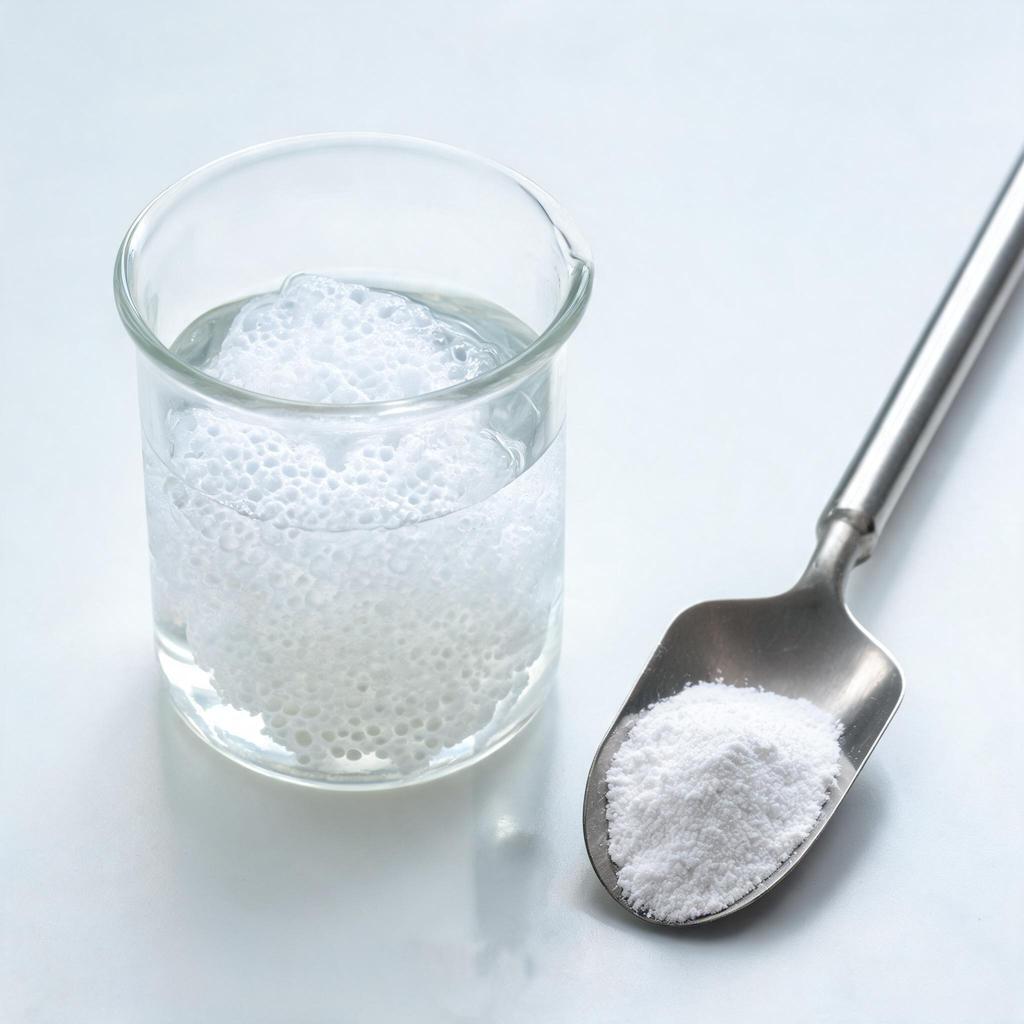
The Mechanics of Superabsorbent Polymer (SAP) Swelling
In the global hygiene products sector, which represents over 65% of the USD 6.49 billion superabsorbent polymer (SAP) market, the core function of materials like poly(acrylic acid) is the rapid retention of liquid. The efficacy of these polymers relies entirely on their swelling ratio (SR)—the quantitative measure of how much water a material can absorb relative to its dry mass. However, achieving a high SR while maintaining strict dimensional stretch compensation presents a profound physical chemistry challenge. As SAP particles transition from a solid powder state to a cohesive, swollen gel, they undergo significant macroscopic deformation. This expansion exerts mechanical stress on the surrounding nonwoven substrates and structural components of diapers or sanitary pads, potentially leading to leakage pathways if the dimensional changes are not precisely compensated by the product's architecture.
The Three Stages of Hydrophilic Network Expansion
To engineer effective dimensional stretch compensation, formulators must deeply understand the three distinct phases of SAP hydration:
- Hydrophilic Attraction (Phase 1): Water molecules rapidly migrate into the polymer network via osmotic pressure. During this phase, the internal free volume expands drastically, generating outward radial forces that push against the particle boundaries.
- Network Expansion (Phase 2): The cross-linked polymer chains begin to uncoil and stretch. The elastic restoring forces of the polymer backbone start to build tension, resisting further expansion.
- Osmotic Equilibrium (Phase 3): The system reaches a steady state where the inward pulling force of the cross-linking elasticity perfectly balances the outward pushing force of the osmotic pressure. At this point, the SAP holds the absorbed water in a rigid, gel-like state.
Modern rheological testing using instruments like ElastoSens Bio measures the shear storage modulus (G') to monitor this exact transition. Industry benchmarks often define "initiation time" as the period required for the forming gel to reach a critical firmness threshold, typically 700 Pa. Formulating an SAP that hits this 700 Pa mark too quickly can result in a brittle, poorly distributed gel; hitting it too slowly risks catastrophic fluid migration before the structural barrier forms.
Chemical Interference: How Odor Scavengers Disrupt Swelling Kinetics
While SAPs excel at absorbing fluids, they also aggressively trap volatile organic compounds (VOCs), particularly ammonia (NH3) and urea derivatives released by human waste. Standard odor control solutions in hygiene products rely heavily on fragrance masking or traditional synthetic deodorizers. These additives frequently introduce foreign ions or alter the local pH microenvironment within the SAP matrix. Because the swelling kinetics of poly(acrylic acid) are highly sensitive to pH—acidic environments suppress carboxylate ionization and slow down water absorption—the introduction of conventional deodorizing agents can inadvertently shift the swelling curve, ruining the carefully calibrated dimensional stretch compensation of the final product.
LumenAxys™ Zinc Ricinoleate: A Non-Ionic Chemical Shield
To solve this paradox, LumenAxys™ introduces plant-based Zinc Ricinoleate as a precision chemical intervention. Unlike heavy-metal salts or quaternary ammonium compounds that act as strong electrolytes and collapse the SAP's internal osmotic gradient, Zinc Ricinoleate operates through targeted coordination chemistry. It features a long-chain unsaturated fatty acid (ricinoleic acid) bound to a zinc center. This molecular architecture allows it to seamlessly integrate into the lipophilic pockets of the SAP network without introducing excess ionic strength that would prematurely halt the swelling process.
When trapped ammonia gas attempts to diffuse out of the saturated SAP gel, the active Zn2+ center in LumenAxys™ acts as an electrophilic trap. The lone pair of electrons on the nitrogen atom of NH3 coordinates directly with the zinc ion, forming a stable coordinate covalent bond. This reaction permanently sequesters the ammonia molecule within the bulk of the polymer, eliminating the olfactory impact while leaving the overall osmotic pressure and hydration dynamics of the SAP completely intact.
Dimensional Stretch Compensation and Rheological Integrity
The integration of LumenAxys™ into SAP formulations ensures that the volumetric swelling ratio remains consistent across varying particle sizes. MRI studies have demonstrated that smaller SAP particles exhibit more homogeneous spatial swelling. By preventing the localized buildup of pressurized, trapped gases—which can cause microscopic "blistering" and uneven expansion within the gel bed—Zinc Ricinoleate promotes a uniform G' profile. This uniformity is critical for the outer shell of hygiene products, allowing the nonwoven layers to stretch evenly and maintain a tight seal against the skin, thereby enhancing both leak protection and consumer comfort.
Industrial Testing Protocols for Optimal Integration
For industrial R&D teams optimizing their next-generation hygiene products, integrating LumenAxys™ requires precise parameter mapping. We recommend the following standardized testing protocols:
- Rheological Modulus Tracking: Utilize oscillatory rheometry to track the shear storage modulus (G') over a 4-minute timeframe. Ensure that the addition of LumenAxys™ does not delay the achievement of the 700 Pa firmness threshold by more than 5 seconds compared to a blank SAP baseline.
- pH Sensitivity Matrix: Test the SAP-LumenAxys™ composite under varying pH conditions (e.g., pH 6.0 vs. pH 7.6). Confirm that the water-to-powder absorption ratio remains stable, proving that the plant-based zinc complex does not induce premature protonation of the acrylic acid chains.
- Ammonia Sequestration Yield: Expose fully swollen SAP gels to a controlled NH3 vapor chamber. Measure the residual headspace concentration after 24 hours to verify permanent scavenging capacity without observing any macroscopic shrinkage or deswelling events in the polymer network.
Frequently Asked Questions (FAQ)
Does LumenAxys™ Zinc Ricinoleate affect the maximum water absorption capacity of my SAP?
No. Because Zinc Ricinoleate is a large, non-electrolyte lipid-zinc complex, it does not significantly contribute to the Donnan osmotic pressure within the SAP network. Therefore, it does not interfere with the fundamental thermodynamic driving force of water absorption, allowing your SAP to achieve its theoretical maximum swelling ratio.
How does this compare to adding standard baking soda for odor control?
Baking soda (sodium bicarbonate) is a small, highly soluble salt. When incorporated into SAPs, it increases the local ionic strength, which can screen electrostatic repulsions between polymer chains and alter the equilibrium swelling state. LumenAxys™ operates via specific molecular coordination rather than general ionic buffering, preserving the delicate rheological balance required for optimal dimensional stretch compensation.
What is the ideal concentration range for adding LumenAxys™ to a commercial diaper formulation?
Formulation parameters depend on the specific SAP base and the target fluid load. Generally, concentrations ranging from 0.1% to 0.5% by weight of the total SAP mass are sufficient to achieve complete ammonia sequestration while maintaining the structural integrity and firmness (G') of the resulting gel matrix. We provide custom rheological profiles for precise titration.