
The Thermodynamic Limitation of Physical Adsorption in High-Purity Industrial Gases
In the chemical process industries (CPI), the generation of ultra-high-purity gases such as hydrogen, nitrogen, and oxygen is a cornerstone of advanced manufacturing. As we transition toward stringent environmental standards and high-tech semiconductor applications, the requirement for removing trace impurities—specifically moisture, carbon monoxide, and volatile sulfur compounds (VOCs)—has escalated to the low parts-per-billion (ppb) level. Traditional gas purification relies heavily on physical separation technologies, most notably Pressure Swing Adsorption (PSA) and Cryogenic Distillation. However, these methods face a fundamental thermodynamic ceiling when dealing with complex, polar, or reactive trace contaminants.
To understand why traditional media fail at the ppb threshold, one must examine the physics of physisorption. In a PSA system, impurity molecules are trapped onto the surface of solid adsorbents like zeolites or activated carbon molecular sieves. This trapping mechanism depends entirely on Van der Waals forces—weak, short-range electrostatic interactions among molecular dipoles. Because these forces are inherently weak and temperature-sensitive, they are easily disrupted by fluctuations in pressure or thermal energy. When an industrial gas stream undergoes rapid expansion or temperature cycling, the equilibrium shifts, causing the desorption of trapped impurities back into the gas phase. For non-reactive gases like argon or methane, this is manageable. But for reactive odorants and toxic trace gases like Hydrogen Sulfide (H2S) or Ammonia (NH3), physical adsorption is often insufficient to guarantee permanent removal.
Chemical Sequestration: The Bioinorganic Advantage of Zinc Ricinoleate
When physical adsorption reaches its capacity limit, the industry requires a mechanism that transcends the reversible nature of Van der Waals interactions. This is where the chemistry of LumenAxys™ Plant-Based Zinc Ricinoleate provides a paradigm shift. By introducing a bioinorganic coordination complex into the final polishing stage of gas purification, engineers can achieve irreversible chemical sequestration.
Zinc Ricinoleate is a unique organometallic compound derived from plant-based sources. Its molecular architecture features a central Zinc ion (Zn2+) coordinated by the carboxylate group of ricinoleic acid. This specific geometric arrangement creates a highly accessible Lewis acidic center. Unlike heavy metal scavengers that pose severe environmental hazards, the Zinc Ricinoleate matrix operates through safe, bioinorganic coordination chemistry. The Zn2+ center possesses a strong affinity for nucleophilic and electron-rich trace gases. When a molecule of H2S passes through the purification bed, it does not merely stick to the surface; it actively forms a stable coordinate covalent bond with the zinc atom, displacing weaker ligands and locking the sulfur atom into a stable tetrahedral complex. This transformation from a free, volatile gas molecule into a bound, non-volatile chemical species prevents any subsequent desorption, effectively breaking the thermodynamic equilibrium that plagues standard PSA systems.
Mechanistic Breakdown of Sulfide Scavenging
- Nucleophilic Attack: The sulfur atom in H2S acts as a strong nucleophile. It attacks the empty d-orbitals of the Zn2+ ion in the LumenAxys™ matrix.
- Coordinate Bond Formation: A stable Zn-S coordinate bond is formed. This bond is significantly stronger than the weak dipole-dipole interactions utilized in standard carbon filters.
- Thermodynamic Sink: The resulting complex has a drastically lower vapor pressure than the original gas. Once captured, the impurity cannot be re-released into the gas stream under normal operating temperatures and pressures.
Industrial Customization and Sampling Methodologies
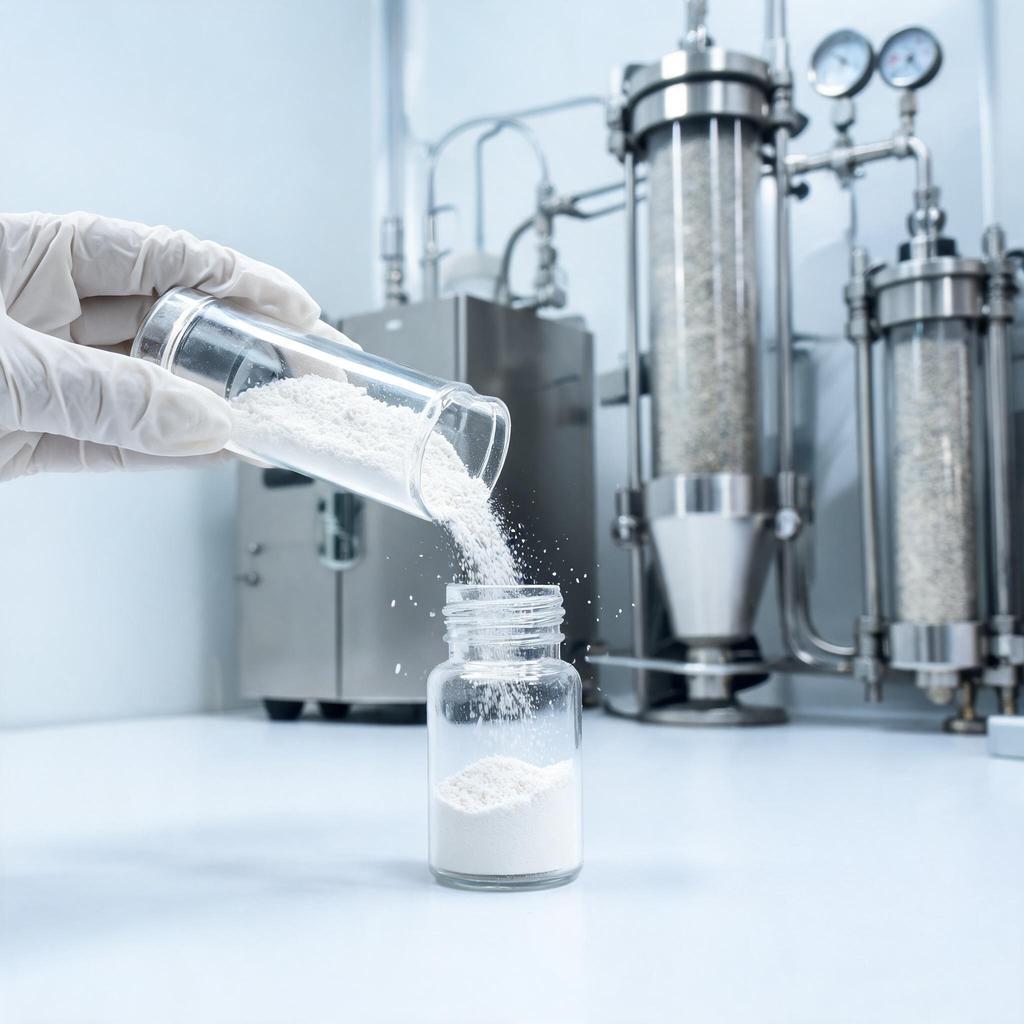
Implementing LumenAxys™ Zinc Ricinoleate in an existing gas purification train requires precise engineering to avoid altering the bulk flow dynamics of the primary gas (e.g., N2 or H2). The material is typically formulated as a high-density, low-volatility powder or encapsulated microsphere that can be integrated into a specialized guard bed following the main cryogenic or PSA column.
To validate the efficacy of this chemical sequestration, rigorous sampling protocols are mandatory. Standard continuous online analyzers may lack the sensitivity for sub-ppb organic sulfur traces. Therefore, our protocol utilizes calibrated 10-liter Tedlar gas sampling bags. The purified gas stream is sampled directly downstream of the LumenAxys™ guard bed. These bags are then analyzed using Flame Photometric Detection (FPD) or Gas Chromatography-Mass Spectrometry (GC-MS) to quantify residual H2S and other sulfides. In controlled pilot tests, LumenAxys™ demonstrated a breakthrough time 4x longer than standard activated alumina when challenged with a 5 ppm H2S feed, maintaining a zero-release state even after a 20% increase in bed temperature.
Comparative Performance: LumenAxys™ vs. Conventional Media
The superiority of chemical sequestration over physical adsorption is best understood through direct comparison of their operational parameters and failure modes.
- Binding Mechanism: Zeolites and Carbon rely on weak, reversible Van der Waals physisorption. LumenAxys™ relies on strong, irreversible coordinate covalent bonding.
- Temperature Sensitivity: Physical adsorbents suffer from "breakthrough" during exothermic spikes or rapid depressurization. The LumenAxys™ chemical bond remains intact across a wide range of industrial operating temperatures.
- Regeneration Requirement: Traditional beds require frequent, energy-intensive regeneration cycles (venting to atmosphere). LumenAxys™ acts as a terminal sink, eliminating the need for complex regeneration hardware.
- Environmental Profile: Many traditional sulfide scavengers utilize heavy metals or toxic solvents. LumenAxys™ is derived from plant-based ricinoleic acid, offering a sustainable, eco-friendly alternative for green industrial processes.
Frequently Asked Questions (FAQ)
Does LumenAxys™ Zinc Ricinoleate alter the bulk purity of Nitrogen or Oxygen?
No. The coordination chemistry of the Zinc Ricinoleate matrix is highly selective for nucleophilic trace impurities like H2S and NH3. It does not react with inert diatomic gases such as N2, O2, or Ar. Therefore, the bulk volumetric purity of the primary gas stream remains unaffected.
How is the LumenAxys™ material introduced into an existing PSA or Cryogenic system?
It is deployed as a dedicated "polishing" or guard bed located immediately downstream of the primary separation column. The material's low volatility and high structural stability ensure it does not migrate into the main gas line or clog downstream instrumentation.
What is the expected service life of the LumenAxys™ guard bed?
Service life is dictated by the cumulative concentration of target impurities rather than time. Because the binding is irreversible and the material offers a high theoretical capacity per unit mass, the bed typically outlasts conventional activated carbon by a significant margin before requiring replacement.